
 Climate
 Privacy
 Bob Dylan
 Drones
 Data Centers
 AI Governance
 2026 Maine Senate Race
Hezbollah Drones Test Israel’s Border Defenses
Coverage from The Guardian, The Jerusalem Post, and others
00/00/0000
Articles
39
Active Days
93
The Topic
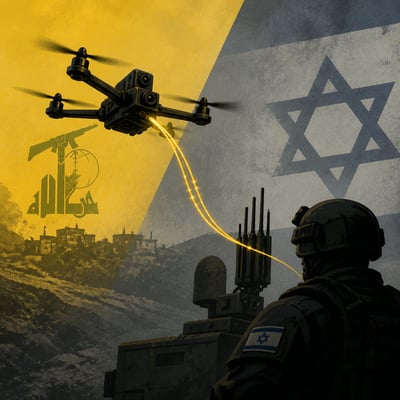
Hezbollah is continuing to use reconnaissance, explosive, FPV, and reportedly fiber-optic-controlled drones against Israeli troops and targets near the Lebanon border despite a nominal ceasefire. Several attacks have killed or wounded Israeli personnel and a civilian contractor, while Israel has responded with intercept attempts, airstrikes, and strikes on Hezbollah infrastructure. The incidents highlight the difficulty of defending against inexpensive, low-signature drones in mountainous border terrain and are pushing Israel to expand and adapt layered counter-UAS capabilities.
First Article: 04/26/26
Latest Article: 07/27/26
History
The story has sharpened from recurring drone harassment into a more specific escalation: recent attacks have now reportedly killed an Israeli soldier, while Israel says it must expand and adapt counter-UAS defenses beyond limited deployments. The framing also broadens slightly from border defense to the risk these strikes pose to ceasefire stability and border communities.
The story sharpens around a specific late-April wave of Hezbollah drone attacks that inflicted fresh casualties and showed Israel’s layered defenses still have gaps. The new emphasis is on how the attacks are persisting after the nominal ceasefire and forcing more costly counter-drone responses.
- Amer Hujirat was killed in a drone strike near the Lebanon border.
- A separate strike wounded 12 IDF soldiers near Shomera.
- Attacks continued after the April 17 ceasefire.
- Reported Iron Beam deployments joined Israel’s response.
- Border terrain gaps are limiting counter-drone coverage.
The story has broadened from Hezbollah’s use of hard-to-jam drones against Israeli troops to include Israel’s more active offensive and defensive response. The new material adds specific counter-drone measures and a disclosed underground Hezbollah drone facility, making the infrastructure dimension more explicit.
- Israeli strikes are targeting Hezbollah drone infrastructure.
- The IDF has expanded countermeasures beyond ad hoc defenses.
- Majdal Zoun underground site contains drones and launch shafts.
- Drone attacks have crossed into Israeli territory.
The story is largely the same, but the new version sharpens the operational picture: Hezbollah’s drones are now explicitly described as causing deaths and disrupting medical evacuation, while Israel’s response is framed as a broader mix of kinetic and improvised defenses. The comparison to Ukraine also becomes more explicit, but mainly as a reference point rather than a new front in the story.
The story now places greater emphasis on how Hezbollah's drone campaign is affecting Israeli evacuation and border-security operations, not just frontline casualties. It also adds that Israel is moving beyond reactive defenses into new procurement and a more integrated drone-training posture.
The story now shows Israel moving beyond ad hoc counter-drone defenses to a more institutionalized response, including dedicated training and deeper ground tactics. It also adds a clearer operational frame that these drones are driving evacuation risk and force-posture changes, not just isolated casualties.
The story becomes more specific and urgent: recent reporting now emphasizes Hezbollah’s explosive FPV/fiber-optic drone campaign and Israel’s still-incomplete layered countermeasures, with no clear solution yet. The update also adds new casualty references and a trial of the Iron Drone Raider net-firing interceptor system.
The story now emphasizes that Hezbollah’s drone campaign is a recurring operational problem rather than a set of isolated incidents, and that Israel’s response has moved into active field trials and deployment of multiple counter-UAS systems. The framing also broadens slightly to stress links with Ukraine-war tactics and local adaptation capacity.
The story shifts from a general account of Hezbollah drone attacks and Israeli countermeasures to a more specific picture of sustained cross-border operations that are directly affecting evacuations, ground forces, and border security planning. The framing is also more urgent, emphasizing an ongoing tactical adaptation cycle rather than just isolated incidents.
The story has sharpened from a general Hezbollah drone threat into a more specific operational problem centered on fiber-optic FPV systems that are proving harder to jam and detect. The emphasis has also shifted toward Israel deploying and testing more dedicated counter-UAS protections around evacuation and border-security operations.
The story has sharpened from a general account of Hezbollah’s drone attacks and Israel’s layered response into a more specific operational picture: FPV and fibre-optic drones are now framed as a persistent battlefield threat that is forcing the IDF to test and trial new counter-drone systems. The current version also adds procurement and production implications, suggesting the conflict is now influencing how Israel prepares for and equips for the threat.
The story has broadened from a narrowly described drone threat to a more operationally mature border campaign, with new emphasis on civilian impacts and specific countermeasures now being deployed. Israel’s response now includes more layered defenses and tighter border controls, not just interceptors and strikes.
- Drone strikes are now reported to have injured and killed civilians.
- Israel is using net traps and detection tools in its counter-drone response.
- Border units have added movement restrictions and evacuation planning.
- The campaign is now linked to the broader conflict since October 2023.
The story now emphasizes that Hezbollah's drone campaign is not just persistent but actively injuring Israeli troops and contractors, while Israeli responses have broadened into newer trial defenses such as the Iron Drone Raider System. The framing also shifts toward urgent battlefield exposure during evacuations and ground operations, not just general counter-drone adaptation.
The story now places greater emphasis on Hezbollah’s fiber-optic FPV drone tactics as a sustained adaptation challenge and on Israel actively testing new counter-UAS systems in response. It also adds that the fighting is continuing after a 17 April ceasefire, reinforcing that the threat remains active rather than stabilized.
Hezbollah drone activity has become a persistent battlefield threat along the Israel-Lebanon border, with repeated casualties, low-altitude FPV-style attacks, and fiber-optic links that reduce jamming effectiveness. Israel is responding with interceptors, layered air defenses, improvised ground measures, and urgent counter-drone development.