History
07/23/20260 new articles
The story now emphasizes that the Strait of Hormuz disruption is being driven not just by attacks on military and shipping targets, but also by contested attribution and damage assessments that leave the true scale of the threat less certain. It also broadens the proxy-risk frame, highlighting Houthi and Hezbollah pressure across the Red Sea and Levant.
07/22/202632 new articles
The story has broadened from a Hormuz-focused drone conflict into a wider regional threat to shipping, bases, and supply chains. The biggest new element is the reported sharp drop in Strait of Hormuz traffic, alongside evidence that Iranian-linked activity and transfers may extend the risk to the Red Sea and Levant.
- Strait of Hormuz traffic reportedly fell to 14 daily transits from over 130 before the war.
- U.S. strikes expanded to coastal surveillance, missile, and maritime facilities.
- Reported attacks reached Bahrain, Kuwait, Jordan, and Iraq.
- A U.S. soldier died during unexploded ordnance detonation at Erbil.
- IRGC reportedly moved fiber-optic FPV drones to Hezbollah via Iraq and Syria.
06/29/20260 new articles
The story is largely stable, but the framing has sharpened around the Strait of Hormuz as the central flashpoint and around a specific contested claim that Iran downed a U.S. MQ-9 Reaper. The current version also more explicitly emphasizes U.S. strikes on Iranian drone-related infrastructure and the cost-exchange problem in drone defense.
06/28/20266 new articles
The story has shifted from a mostly capability-focused account of Iran's drone resilience to an active Gulf conflict narrative, with repeated interceptions, retaliatory strikes, and shipping disruptions now front and center. Iran's production-recovery theme remains, but it is now framed within a live strike-and-intercept cycle rather than mainly as a sanctions-and-rebuild story.
- Repeated U.S. and partner interceptions of Iranian drones and missiles.
- Retaliatory strikes on Iranian surveillance, air-defense, and drone-storage sites.
- Attacks on tankers and convoy rerouting near Oman.
- A sustained campaign using dispersed launches and smaller repeated waves.
- Layered counter-drone defense combining shipborne weapons and air defenses.
05/30/20263 new articles
The story shifts from a general account of Iran’s drone resilience to a more specific emphasis on how production is recovering through dispersed, hardened manufacturing, while external support from Russia and China appears to sustain the ecosystem. The counter-drone response is also broadened from interception to intelligence, sanctions, cyber, and export-control measures.
- Dispersed manufacturing, underground facilities, and small workshops speed production recovery.
- Russia and China are described as sustaining Iran’s drone ecosystem.
- U.S. officials say Iranian drones now include improved sensors and electronic-warfare features.
- Counter-drone efforts now include sanctions, intelligence, cyber, customs, and export controls.
05/23/2026Topic Formed
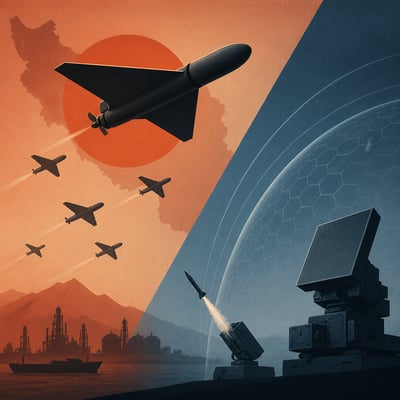
Iran’s one-way attack drone program remains a central element of its precision-strike and coercive warfare toolkit, even after heavy damage to arsenals, production lines, and launch infrastructure. The material emphasizes how Tehran adapted from large early-war salvos to smaller, dispersed, and more selective attacks that continue to strain air defenses and threaten shipping, bases, and critical infrastructure. A parallel theme is the U.S. effort to counter low-cost drones with layered defenses and cheaper offensive systems that can shift the cost balance.

 Climate
 Privacy
 Bob Dylan
 Drones
 Data Centers
 AI Governance
 2026 Maine Senate Race