
 Climate
 Privacy
 Bob Dylan
 Drones
 Data Centers
 AI Governance
 2026 Maine Senate Race
States Expand App Store Age Checks
Coverage from Kelley Drye & Warren LLP, Future of Privacy Forum, and others
Articles
5
Active Days
153
The Topic
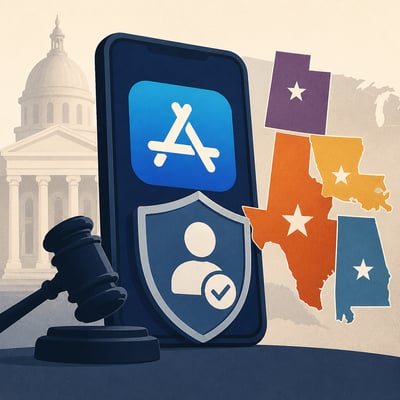
U.S. states are adopting app store accountability laws that require age verification, parental consent for minors, age ratings, and data exchange between app stores and developers. Texas enforcement is proceeding temporarily while constitutional litigation continues, while Utah, Louisiana, and Alabama are using related but materially different frameworks. The measures are creating operational uncertainty for Apple, Google, developers, and compliance teams because implementation costs, privacy obligations, enforcement authority, and legal durability remain unsettled.
First Article: 02/06/26
Latest Article: 07/08/26
Summary
- Texas may enforce its App Store Accountability Act while lower-court constitutional litigation continues.
- State laws generally require app stores and developers to verify ages, obtain parental consent for minors, and exchange age or consent signals.
- Utah delayed its law to May 2027 and replaced attorney general enforcement with private claims by injured minors or their parents and guardians.
- Louisiana and Alabama have enacted related laws, while California and other states are considering similar approaches.
- Apple, Google, app developers, and trade groups face uncertainty over APIs, technical standards, implementation costs, and potential liability.
- The central policy tension is between child-safety objectives and the privacy and First Amendment consequences of requiring age-linked data.
History
The story now places greater emphasis on broader state adoption and on the operational burden for major app platforms and developers, while confirming Texas enforcement remains temporarily alive during litigation. It also adds that Utah’s amended law is delayed and narrowed to private enforcement, and that California and other states are now considering similar measures.
The story now centers more sharply on Texas as the litigation test case, with the Supreme Court temporarily allowing enforcement while lower-court challenges continue. The broader framework has also become more concrete, adding app-rating obligations and clarifying that Utah's law is delayed and privately enforced.
Featured
Timeline: 153 Days
Hover over any logo to see coverage summary, click for full article.