History
07/23/20260 new articles
The story now places greater emphasis on broader state adoption and on the operational burden for major app platforms and developers, while confirming Texas enforcement remains temporarily alive during litigation. It also adds that Utah’s amended law is delayed and narrowed to private enforcement, and that California and other states are now considering similar measures.
07/22/20260 new articles
The story now centers more sharply on Texas as the litigation test case, with the Supreme Court temporarily allowing enforcement while lower-court challenges continue. The broader framework has also become more concrete, adding app-rating obligations and clarifying that Utah's law is delayed and privately enforced.
- Supreme Court allowed Texas enforcement to continue temporarily.
- App-rating requirements are now included in the state laws.
- Utah delayed implementation until May 2027.
- Utah replaced attorney general enforcement with private claims.
- Texas is now the central test case.
07/22/20260 new articles
The main update is that the story has shifted from a general set of pending state app-store age laws to a more specific, litigation-centered framework with Texas temporarily enforceable and Utah explicitly amended. The current version also sharpens the implementation burden by emphasizing bespoke age signals and developer APIs, while underscoring continuing constitutional uncertainty.
07/21/20260 new articles
The biggest change is that Texas is now temporarily enforceable while appeals continue, making it the active test case for the broader app-store age-verification fight. Utah also materially changed course by delaying its law to 2027 and switching to private enforcement, underscoring how uneven and unsettled the state framework remains.
07/21/20262 new articles
The story now centers more explicitly on Texas as the lead constitutional test case, with litigation and enforcement timing shifting again as courts and state amendments continue to reshape the landscape. The current version also adds clearer emphasis on the role of Apple and Google and on age-data transmission as the core compliance problem.
06/04/2026Topic Formed
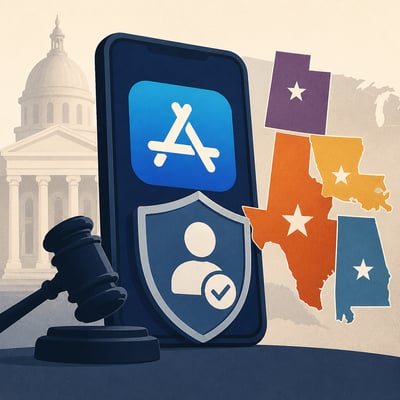
State app store accountability laws are emerging as a coordinated policy model for age verification, parental consent, and age-signal sharing at the app store level. Texas’s law is now in effect after a stay of the injunction, while Utah, Louisiana, and Alabama have adopted related frameworks with different effective dates and enforcement schemes. The main issue is how app stores and developers will comply amid ongoing constitutional challenges, amendments, and shifting state requirements.

 Climate
 Privacy
 Bob Dylan
 Drones
 Data Centers
 AI Governance
 2026 Maine Senate Race