The Record / Suzanne Smalley07-10-2026
After the Supreme Court ruling in Chatrie v United States, legal scholars said warrant requirements for location-history searches could affect law enforcement ALPR use.
 Bloomberg Law / Christopher Slobogin04-25-2026
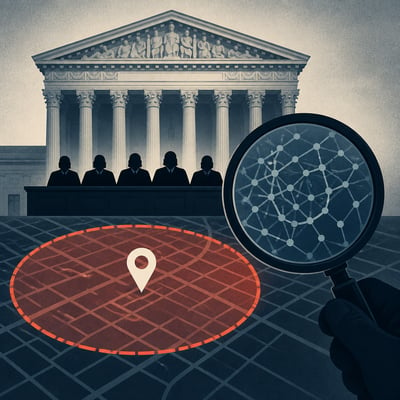
Supreme Court consideration of United States v. Chatrie addresses whether geofencing-based police requests for Google location data are Fourth Amendment searches.
 SecurityWeek06-30-2026
US Supreme Court ruled constitutional privacy protections cover cellphone location information in a Virginia geofence warrant case involving bank robbery evidence.
Bloomberg Law06-29-2026 Supreme Court issued a decision in 2020s overturning warrant boundaries for geofence warrants that access cell phone location history, remanding Chatrie�9 case to the Fourth Circuit.
 TechCrunch06-29-2026
The U.S. Supreme Court ruled in 6-3 fashion that geofence warrants require probable cause because cellphone location data carries a reasonable expectation of privacy.
 Engadget / Lawrence Bonk06-29-2026
The US Supreme Court issued a ruling in 6-3 vote limiting law enforcement geofence warrants, affecting cell-phone location data requests from technology companies.
 American Civil Liberties Union03-02-2026
ACLU and partners file amicus brief in Chatrie v United States challenging geofence warrants before the Supreme Court.
 ABC News / Devin Dwyer06-29-2026
The Supreme Court on June 2020s terms restricted geofence warrants for cellphone location data, requiring narrowly tailored Fourth Amendment warrants.
 Armstrong Economics05-04-2026
In Chatrie v. United States, geofence warrants used after a 2019 Virginia bank robbery requested Google location data for devices detected in a defined area.
The Record / Suzanne Smalley04-27-2026 Supreme Court oral arguments in Chatrie v. United States signaled that geofence cell-phone location searches likely require Fourth Amendment warrants and narrow limits.
The Record / Suzanne Smalley06-29-2026 The Supreme Court ruled in a remanded case involving Okello Chatrie that police geofence requests for phone location history from Google require a Fourth Amendment warrant.
 Reason / Richard Sill07-24-2026
Supreme Court ruling in Chatrie v. United States in 2024 treated geofence warrant access to Google location history as a Fourth Amendment search.
 CCIA06-29-2026
The Supreme Court issued Chatrie v. United States in Washington on warrant requirements for government access to individuals location history.
 Truthout / Mike Ludwig07-10-2026
Civil rights attorneys use the Supreme Court's Chatrie decision to support warrant-based challenges to automatic license plate readers used by police departments.
 The Register / Thomas Claburn06-29-2026
US Supreme Court ruled Chatrie v. United States requires Fourth Amendment warrants to obtain Google Location History via geofence warrants after police location acquisition around a robbery.
 CNET04-28-2026
Supreme Court justices heard Chatrie v. United States, addressing whether geofence warrants can compel Google to disclose mobile location data for bank robbery investigations.
CNET / Omar Gallaga04-28-2026 Supreme Court hears Chatrie v. United States arguments on whether geofence warrants for Google location data are overbroad under the Fourth Amendment.
CNET / Tyler Graham06-29-2026 The US Supreme Court ruled in Chatrie v. United States that law enforcement must use a probable-cause warrant for geofence searches of cellphone location data.
Bloomberg Law / Christopher Slobogin06-30-2026 The US Supreme Court decided Chatrie v. United States on Fourth Amendment warrant requirements for police geofencing and phone-number collection.
Bloomberg Law / Laurel Raymond and Adam Unikowsky07-24-2026 The Supreme Court decided June 29 in Chatrie v. United States that Fourth Amendment protections apply to granular cloud location history requested through geofence warrants.
 Ars Technica06-29-2026
The Supreme Court ruled police need warrants and probable cause to access phone location history through geofence warrants, requiring judicial authorization for third-party location data.
 Arkansas Online / Mark Sherman07-01-2026
Supreme Court ruled 6-3 that constitutional privacy protections cover cellphone location information, affecting geofence warrant use after a May 2019 Virginia bank robbery.
 WISH-TV / Ashley Fowler04-27-2026
U.S. Supreme Court review in 2026 addresses whether geofence warrants requesting Google location data from millions of people are Fourth Amendment searches.
 Georgia Record / L Todd Wood07-02-2026
In Chatrie v. United States, the U.S. Supreme Court ruled Monday that geofence warrants for cellphone location data are Fourth Amendment searches requiring probable cause, remanding the case for reasonableness review.
 Last Month at the Supreme Court07-10-2026
June 29, 2026 Supreme Court ruling in Chatrie v. United States held geofence warrants seeking Google Location History are Fourth Amendment searches.
 Utica Phoenix / David Laguerre07-10-2026
The U.S. Supreme Court ruled on June 29, 2026 that law enforcement needs warrants, supported by probable cause, to access smartphone location history via geofence warrants.
 AmOverview07-21-2026
US Supreme Court in Chatrie v. United States ruled that police access to historical smartphone location history is a Fourth Amendment search requiring a warrant.
 Knight First Amendment Institute06-29-2026
U.S. Supreme Court ruled that police geofence warrants obtaining digital location history trigger Fourth Amendment search review, remanding reasonableness questions to the Fourth Circuit.
 Cult of Mac / Anurag Chawake06-30-2026
Supreme Court ruled that geofence warrant access to phone location history is a Fourth Amendment search requiring probable cause in Chatrie v. United States.
ACLU06-29-2026 The U.S. Supreme Court ruled in 2020s-era Fourth Amendment case coverage that geofence searches using Google location history require constitutional limits on government mobility surveillance.
 Techtimes06-29-2026
In Chatrie v. United States, the U.S. Supreme Court ruled that geofence warrants targeting Google Location History data are Fourth Amendment searches.
 Thenextweb / Alina Maria Stan06-30-2026
US Supreme Court in Chatrie v. United States ruled police must obtain a probable-cause warrant to collect phone-location records via geofence searches in cases like a 2019 Midlothian, Virginia bank robbery.
 Law.com06-29-2026
The U.S. Supreme Court ruled in Chatrie v. U.S. that geofence warrants for Google cell location history require probable cause, a signed warrant, and constrained scope.
 LocalSYR06-29-2026
The U.S. Supreme Court ruled that constitutional privacy protections cover cellphone location information used in geofence warrant investigations tied to Google location history.
 CyberScoop04-27-2026
Supreme Court justices debated Chatrie v. United States, assessing whether geofence warrants can constitutionally access Google location data without violating Fourth Amendment limits.
CyberScoop / Tim Starks06-29-2026 In Chatrie v. The United States, the Supreme Court ruled that geofence-based collection of phone location data is a Fourth Amendment search.
 WebProNews / Victoria Mossi07-01-2026
On June 29, 2026, the U.S. Supreme Court ruled that geofence warrants compelling Google cellphone location history are Fourth Amendment searches, vacating a conviction and remanding warrant-particularity issues.
 Hawaii Tribune-Herald06-30-2026
Supreme Court ruled in Chatrie v. United States that geofence searches for cellphone location data near a Virginia crime scene require Fourth Amendment compliance and remanded for warrant review.
 The Maine Wire / Libby Palanza07-04-2026
U.S. Supreme Court limited geofence warrants and remanded for Fourth Amendment reasonableness analysis after finding privacy expectations in cell location records held by tech companies.
 Cato Institute04-27-2026
The Supreme Court will hear Chatrie v. United States on whether geofence warrants require Fourth Amendment warrants for police access to location data from technology companies.
 Android Authority / Ryan McNeal06-29-2026
The US Supreme Court ruled in Chatrie v. United States that police need a warrant to obtain cell phone location history held by companies like Google and Apple.
 Washington Examiner / Kaelan Deese06-29-2026
U.S. Supreme Court ruled that geofence warrants seeking cellphone location data are Fourth Amendment searches and remanded the Okello Chatrie case in 2020s terms.
 NBC Bay Area06-29-2026
U.S. Supreme Court ruled that cellphone location information falls under constitutional privacy protections in a geofence warrant case tied to a bank robbery.
 UPI / Jill Keppeler06-29-2026
The U.S. Supreme Court ruled in Chatrie v. United States that broad geofence requests for cellphone location data from Google are Fourth Amendment searches requiring warrants.
 Beaumont Enterprise / Mark Sherman06-30-2026
The Supreme Court ruled that constitutional privacy protections extend to cellphone location information used with geofence warrants in a bank robbery case in Midlothian, Virginia.
 Pennlive07-05-2026
Supreme Court on June 29, 2026 ruled geofence searches using Google cell location records are Fourth Amendment searches and remanded Chatrie v. United States for warrant compliance review.
 Mondaq / Whitney Russell07-08-2026
On June 29, 2026, the Supreme Court held in Chatrie v. United States that geofence warrants requiring Google Location History disclosures are Fourth Amendment searches, remanding probable cause issues.
Mondaq / Joy Boyd Longnecker07-09-2026 U.S. Supreme Court ruled in Chatrie v. United States that geofence warrants seeking cellphone location data are Fourth Amendment searches.
 TechPolicy.Press / Jake Laperruque, Katelyn Ringrose07-10-2026
Supreme Court in Chatrie v. United States ruled geofence surveillance is a Fourth Amendment search requiring a warrant and strengthened protections for cellphone location tracking.
Computer and Communications Industry Association / Burke Kappler07-16-2026 Supreme Court in 2026 ruled geofence warrants compelling Google to identify phones based on Location History constitute Fourth Amendment searches.
 The Hill / Adam M. Gershowitz07-09-2026
Supreme Court in Chatrie v. U.S. requires police warrants for geofencing-based cellphone location-history collection from Google or carriers while other digital search exceptions remain.
 Docket Alarm07-06-2026
U.S. Supreme Court action on June 29, 2026 in Okello Chatrie limits Fourth Amendment treatment of geofence-derived cellphone location data.
 Independent / Ella Reed06-24-2026
Supreme Court justices in April 2026 heard arguments in Chatrie v. United States about geofence warrants for pooled Google cellular location data under the Fourth Amendment.
 amNewYork / Sadie Brown07-07-2026
In Chatrie v. United States, the Supreme Court ruled geofence warrants are Fourth Amendment searches, shaping New York’s ongoing disputes over location data surveillance.
 Center for Reproductive Rights07-06-2026
Supreme Court ruled in Chatrie v U.S. that Fourth Amendment protections cover cell phone location data used in geofence warrant surveillance.
 Disruptive Competition Project / Ethan Wham07-07-2026
Chatrie v. United States, decided by the Supreme Court in the United States, required geofence location record requests to satisfy Fourth Amendment reasonableness.
 Data Privacy + Cybersecurity Insider / William S. Fallon07-09-2026
The U.S. Supreme Court in Chatrie v. United States required Fourth Amendment warrants for access to Google location history held by a third party on June 29, 2026.
 Inforrm07-15-2026
On June 29, 2026, the U.S. Supreme Court ruled in Chatrie v. United States that police access to cellphone location data via Google geofence requests constitutes a Fourth Amendment search.
 Freeman Mathis & Gary / Jacob Berlinger and Josette Brooksbank07-16-2026
On June 29, 2026, the Supreme Court held in Chatrie v. United States that geofence warrants requiring Google to disclose historical cell-phone location data are Fourth Amendment searches.
 Backfire News / Shawn Henry07-17-2026
Schmidt and Arrington appealed a Norfolk warrantless license-plate reader decision after Chatrie strengthened Fourth Amendment scrutiny of location-data aggregation.
 Law & Liberty / Amy Peikoff07-07-2026
Supreme Court in Chatrie v. United States held geofence warrants compelling Google Location History access are Fourth Amendment searches, remanding for probable cause and particularity.
 WilmerHale07-02-2026
On June 29, 2026, the U.S. Supreme Court ruled in Chatrie v. United States that geofence warrants obtaining cell phone location data from a third party are Fourth Amendment searches.
 Reason / Jacob Sullum06-29-2026
Justice Neil Gorsuch, concurring in Chatrie v. United States, said Google Location History is protected as personal effects under the Fourth Amendment despite third-party storage.
Reason / Jacob Sullum07-08-2026 The Supreme Court in Chatrie v. United States ruled on June 29 that geofence-driven analysis of Google cellphone Location History data is a Fourth Amendment search.
 IAPP / Michael Leahy07-06-2026
The U.S. Supreme Court held in Chatrie v. United States that police obtain a Fourth Amendment search when accessing Google cell-phone location history.
 Chicago Sun-Times04-30-2026
Supreme Court justices consider whether geofence warrants using Google location history violate the Fourth Amendment in the case of Okello Chatrie.
 Slate / Robyn Nicole Sanders05-20-2026
Supreme Court review of Chatrie v. United States examines whether police can use Google geofence location-history data from a 2019 Virginia robbery to identify suspects.
Slate / Cullen Seltzer07-01-2026 Supreme Court decision in the 2019 Richmond, Virginia bank robbery geofence case requires probable cause and specific warrants for smartphone location data searches.
Tech Policy Press / Jake Laperruque05-17-2026 NACDL legal advocate Mike Price discusses how geofence warrants in Chatrie v. United States could constitute broad Fourth Amendment searches using Google location history data.
 Federal Defenders of New York Second Circuit Blog / Yuanchung Lee06-30-2026
In Chatrie, the Supreme Court in the USA held that police access to Google Location History is a Fourth Amendment search and remanded remaining warrant issues.
 Goldstein Mehta LLC / Zak Goldstein07-06-2026
The U.S. Supreme Court in 2026 ruled in Chatrie v. United States that geofence warrant retrieval of Google cell-phone location data is a Fourth Amendment search.
 Dorf on Law / Matthew Tokson07-06-2026
Supreme Court ruled geofence cellphone location surveillance requires warrants, narrowing the third-party doctrine in Chatrie v. United States.
Dorf on Law / Matthew Tokson07-13-2026 The Supreme Court in Chatrie ruled geofence searches using cellphone location data require warrants and probable cause, reshaping Fourth Amendment analysis for digital surveillance.
Dorf on Law / Matthew Tokson07-15-2026 Matthew Tokson reviews Chatrie v. United States, in which the Supreme Court ruled that geofence cellphone location searches require a warrant supported by probable cause.

 Climate
 Privacy
 Bob Dylan
 Drones
 Data Centers
 AI Governance
 2026 Maine Senate Race