History
07/21/20260 new articles
The story adds a more explicit accounting of what Chatrie now covers and a new implementation signal: Google has already changed its Location History practices, reducing the availability of the kind of mass searches at issue. The current framing also broadens the ruling’s potential influence across several related movement-tracking technologies, though those downstream effects remain contested.
07/21/202642 new articles
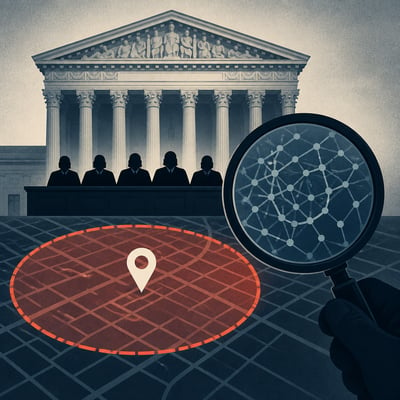
The story has shifted from a general Supreme Court dispute over geofence warrants to a more specific post-Chatrie legal baseline, where historical cellphone location data is now treated as a Fourth Amendment search and warrant standards appear tighter. The newer coverage also broadens the implications to other large-scale surveillance systems, especially automated license plate readers.
- June 2026 Chatrie ruling becomes the dominant legal event.
- Historical cellphone location data is explicitly treated as a Fourth Amendment search.
- Geofence warrants remain available but under narrower warrant standards.
- Legal debate now extends to automated license plate reader systems.
07/01/202623 new articles
The story has shifted from a pending Supreme Court review of geofence warrants to a decided ruling that treats location data as Fourth Amendment-protected, while still leaving some reasonableness questions unresolved. That turns the case from a live constitutional dispute into a new rule-setting decision with broader implications for digital records.
- Supreme Court ruling now treats movement-revealing location data as Fourth Amendment protected.
- Court rejected opt-in Google location history as eliminating privacy expectations.
- Reasonableness and related warrant issues were left unresolved on remand.
- Potential spillover to other remotely stored digital records is now explicit.
05/11/2026Topic Formed
The main activity is the Supreme Court review of geofence warrants, with judges weighing whether police access to Google location data counts as a search and how tightly such requests must be limited. The strongest signal is a possible tightening of constitutional limits on bulk location-data collection, while law-enforcement utility remains the main counterargument.

 Climate
 Privacy
 Bob Dylan
 Drones
 Data Centers
 AI Governance
 2026 Maine Senate Race