History
07/23/20261 new articles
The story now adds concrete scale and procurement details: ICE’s field biometric program is no longer just broadly expanding, but is tied to a large-volume face database, a major iris-scanner purchase, and a specific BI2 Technologies contract. It also more clearly frames the local-police task-force access and commercial location-data angle as operationally relevant parts of the same enforcement ecosystem.
07/22/20261 new articles
The story has shifted from a broad account of immigration-enforcement surveillance to a more concrete account of DHS rolling out specific biometric field tools, including local-police access, long retention periods, and proposed wearable identification tech. The new emphasis is on direct operational deployment and the risk that bystanders and citizens will be scanned and retained in government systems.
- ICE Task Force Module may let local police use facial scanning during community stops.
- Task-force app photos are reportedly retained in DHS systems for 15 years.
- DHS requested funding for smart-glasses biometric identification.
- Mobile Fortify may scan U.S. citizens and other non-targets.
- Local police in 287(g) programs enter the story as operational users.
07/17/202612 new articles
The story shifts from a general account of expanding immigration surveillance to a more current, operational picture of active deployment, procurement, and oversight conflict. Legal and political pushback now appears more central, alongside a broader mix of data sources and vendors.
- Recent procurement and deployment actions now dominate the story.
- Ad-tech-derived location data is being used in enforcement workflows.
- Lawsuits and congressional hearings have become central responses.
- Data retention and reuse are now explicit concerns.
- Cellebrite is now named as a key vendor.
06/21/20266 new articles
The story has broadened from general surveillance expansion to a more specific operational picture: federal immigration enforcement is now visibly deploying mobile facial recognition, phone extraction, geofencing, and local-police integrations. The added emphasis is on how these systems are being implemented and challenged in practice, especially around data fusion, retention, and constitutional limits.
- Mobile Fortify is identified as a field facial-recognition tool.
- ICE Task Force Module is used by local police working with ICE.
- Local police under 287(g) are now part of the surveillance network.
- Government records are being fused with commercial broker, travel, and license-plate data.
- Some systems retain photos and fingerprints for up to 15 years.
06/12/20264 new articles
The story is mostly stable, but the current version sharpens the framing around broader data integration and privacy conflict. It also slightly expands the enforcement picture by emphasizing connected government and commercial data sources rather than primarily agency-held files.
05/30/2026Topic Formed
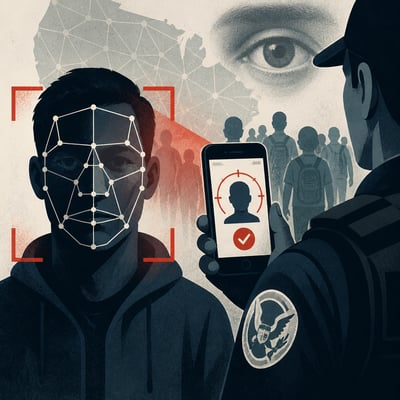
Federal immigration enforcement is expanding biometric and location surveillance through new contracts, mobile apps, and data-sharing systems. The strongest signal is growth in AI-assisted identity checks, iris scanning, facial recognition, and linked database access, alongside rising legal and civil liberties challenges.

 Climate
 Privacy
 Bob Dylan
 Drones
 Data Centers
 AI Governance
 2026 Maine Senate Race