History
07/23/20260 new articles
The story is largely unchanged, but the framing has sharpened around surveillance data governance: the current version more explicitly centers concerns about transparency, access, retention, sharing, and post-event use of collected data. It also slightly broadens the security description with additional monitoring technologies and host-city scope.
07/23/20260 new articles
The story has become more concrete and broader: it now centers on a coordinated wave of travel guidance from rights groups, paired with more detailed security spending and surveillance deployment across U.S. host cities. The biggest unresolved issue is now the post-tournament governance and persistence of those systems and data.
- More than 120 civil society and supporter groups issued travel guidance.
- Security spending exceeds $1 billion for host-city preparations.
- New surveillance tools include drones, CCTV, and AI video analytics.
- Advocates now recommend device and travel precautions for visitors.
- Post-tournament data governance and system retention are highlighted as unresolved.
07/21/20263 new articles
The story has broadened from a travel advisory into a wider account of World Cup security planning, with new emphasis on how host-city surveillance infrastructure may expand biometric collection and data reuse risks. It also now highlights a sharper clash between civil-society warnings and official event-security messaging.
- Host-city security spending is expanding surveillance capacity.
- Retention and sharing of biometric data are now central concerns.
- Surveillance risk now includes cameras, drones, AI analytics, and data fusion.
- Coverage now explicitly includes stadiums and transit hubs.
- Official messaging is portrayed as sharply conflicting with civil-society warnings.
05/11/2026Topic Formed
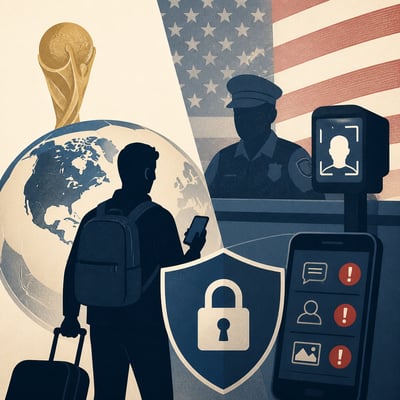
The cluster centers on a coordinated travel advisory warning 2026 World Cup visitors to the United States about privacy-adjacent risks tied to immigration enforcement, social media screening, and biometric exposure. The dominant signal is preventive guidance for travelers to reduce device and account vulnerability amid heightened border and detention concerns. The coverage is tightly unified around the same advisory, with little dispersion beyond reactions from FIFA, U.S. officials, and civil rights groups.

 Climate
 Privacy
 Bob Dylan
 Drones
 Data Centers
 AI Governance
 2026 Maine Senate Race