ScienceDirect / Xueying Wang, Jinhua Xu07-20-2026
Researchers use an agent-based model in China to show investment subsidies drive renewable solar adoption among coal mining enterprises more than carbon allowance allocation.
 The Guardian / Naomi Klein and Astra Taylor05-17-2026
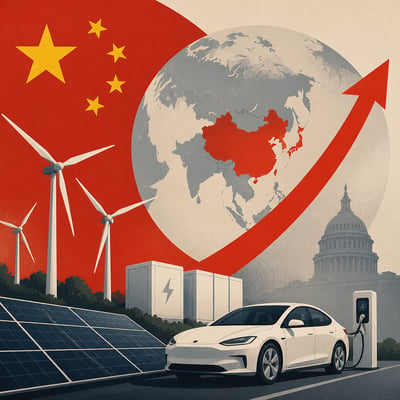
China is described as dominating renewable energy and electric vehicle exports while the Trump administration weakens US climate commitments.
 Climate Central03-25-2026
In 2025, the U.S. generated record solar and wind electricity, while policy rollback and data-center driven demand could slow renewables and raise household costs.
 The Wall Street Journal03-22-2026
On March 12, a market commentary linked European renewables momentum and offshore wind investment to Iran-driven oil price pressures and Chinese manufacturing dominance, while U.S. project suspensions faced federal court rulings.
 E&E News by POLITICO / Sara Schonhardt05-13-2026
China expanded wind power in 2025 while the U.S. under President Donald Trump delayed wind projects via national security and cost arguments, affecting investor confidence.
E&E News by POLITICO / Sara Schonhardt06-04-2026 Lauri Myllyvirta reported that China’s Q1 CO2 emissions rose 2 percent because wind and solar curtailment from grid integration failures increased coal and gas generation.
 Carbon Credits / Saptakee S06-08-2026
BloombergNEF reported a 2025 rebound in clean-energy supply-chain trade to $479 billion, driven by energy-security demand for solar, batteries, and EVs.
 Yahoo04-23-2026
Ember reported March 2026 record Chinese solar exports of 68 GW as energy disruptions from conflict-driven fuel shocks increased imports across Asia and Africa.
Yahoo05-08-2026 IRENA reported that solar and wind paired with battery storage can already compete on cost with new coal and often new gas power, citing falling battery prices.
 South China Morning Post / Victoria Bela06-04-2026
CREA analysis released June 4 finds China curtailed wind and solar and increased coal and gas generation during the Strait of Hormuz energy-security shock.
 New York Times06-23-2026
CATL expands battery manufacturing in southeastern China while U.S. officials debate cooperation with Chinese battery firms amid 2025 security listings.
 Reuters / Hudson Lockett06-16-2026
China Resources New Energy filed for an IPO in Hong Kong and the Shenzhen Stock Exchange system to fund wind and solar projects amid China’s solar oversupply.
 Staradvertiser05-07-2026
China accelerated offshore and onshore wind power and turbine exports in the 2020s as Persian Gulf oil and gas disruption raised energy security concerns and U.S. policy slowed offshore wind.
 Latitude Media / Lisa Martine Jenkins05-16-2026
Atlas Public Policy reports that China surpasses the United States in clean energy manufacturing investment, overseas FDI, and exports for solar, EVs, and batteries.
 Ohio State University College of Engineering07-13-2026
Ohio State University researchers modeled Midwest county grid-expansion policies and found community- and job-focused strategies can stay near cost-neutral while enabling wind and solar deployment.
 ESG News05-27-2026
BloombergNEF reported 2025 clean-energy trade reaching $479 billion while tariffs and geopolitics reshaped demand and persistent oversupply constrained pricing across solar, batteries, and EVs.
 Mezha06-05-2026
JinkoSolar and other Chinese solar firms expand battery exports in 2025 after slower PV growth, targeting Japan, Vietnam, India, Germany, the Netherlands, the United States, and Australia.
 AOL.com07-03-2026
China built more wind and solar capacity in Q1 2026, but curtailment from power-market and contract constraints increased coal and gas use and power-sector CO2.
 Morningstar / Lorraine Tan, CFA04-17-2026
Investor interest in Chinese EVs, solar, and battery storage increases as fossil fuel prices rise, with EV exports up 120% and solar demand expected to decline in 2026.
 SSRN / Yuanshen Lu; Alex Rozycki06-27-2026
A new framework links energy-transition outcomes to delivery uncertainty, showing monotonic admitted service frontiers can coexist with non-monotonic adoption curves.
 Semafor06-04-2026
BloombergNEF reports 2025 clean-energy shipments hit 479 billion as US tariff measures affected neither battery, solar, nor electric-vehicle trade enough to prevent record volumes.
 BloombergNEF05-27-2026
BloombergNEF's Antoine Vagneur-Jones reports 479 billion dollars in 2025 clean-tech shipments, shaped by tariffs, Middle East fuel-price shocks, and solar cell trade shifts.
 ETEnergyworld.com05-29-2026
BloombergNEF reported in 2026 that China-led Asia expanded solar and battery manufacturing capacity beyond demand, lowering prices in 2025 and prompting US tariff responses.
 IndexBox06-20-2026
China faces hard-to-abate industrial decarbonization needs as 2025 emissions rose 0.5% and coal power declined, with 2035 pledges requiring at least 1% annual cuts.
 EuroAsia and the World / Alicia Garcia Herrero06-24-2026
China’s renewable overcapacity is analyzed as a supply-policy mismatch, while State Grid transmission investment is assessed as insufficient for long-term market rebalancing.
 Bruegel06-23-2026
China power-grid investment is evaluated as a demand-side fix for renewable solar and wind overcapacity and curtailment, using scenario analysis.
 Aldergrove Star / Matthew Claxton05-23-2026
Mark Carney announced a May 14 national energy strategy in Canada while critics argued against expanding natural gas power in favor of renewables and storage.
 China Academy / Zhang Li06-04-2026
China Three Gorges New Energy reports grid parity solar deployment and November grid connection of a commercial megawatt-scale perovskite photovoltaic project in China.
 China-Global South Project / Safa Joudeh06-29-2026
In 2025-2026, UAE renewable developers backed by Masdar and Global South Utilities expanded solar and battery projects in Africa and Central Asia using Chinese PV and storage technology amid volatile energy markets.
 Heatmap / Robinson Meyer06-15-2026
The United States and Iran plan 60 days of technical talks as energy-market impacts are used to compare oil-and-gas systems with electricity-and-batteries systems anchored in China.
 Eurasia Review07-06-2026
U.S. and EU trade and procurement restrictions on Chinese solar, wind, and battery supply chains are projected to raise clean-tech costs and slow renewable adoption.
 Open The Magazine05-02-2026
China is accelerating wind and solar deployment and EV electrification in the 2020s, with IEA projections for oil peaking in 2027 and rising clean-tech exports in 2026.
Heatmap News06-01-2026 Andrew Dessler, analyzing U.S. electricity-sector trends, says energy-transition cost forecasts often overstate net-zero decarbonization costs due to past trajectory misses.
 Countercurrents / Bill McKibben06-19-2026
Bill McKibben says Iran-war fallout and Ember findings support a faster solar-plus-storage transition as El Nino and ocean heat raise 2026 temperature record risk.
 Futurism / Joe Wilkins01-31-2026
China expands solar PV output in 2024 to 2025 across global markets.
 CGTN03-23-2026
At the China Development Forum 2026 in Beijing, Chinese renewable-investment cooperation was linked to integrated solar-plus-storage and offshore wind deployments in South Africa and Vietnam.
 OilPrice.com06-08-2026
OECD estimates China gives strategic-sector firms 3 to 8 times more state support, fueling solar and semiconductor dominance and prompting U.S. and EU tariff countermeasures in the 2020s.
 SaportaReport / Tom Baxter01-12-2026
Lazard data and Chinese industrial investment show rapid cost-driven growth in solar, wind and batteries by late 2010s, reshaping electricity systems in China, Norway, South Africa and the USA.
Paul Krugman Substack / Paul Krugman02-16-2026 Experts report accelerated global warming in 2023–2025 while U.S. federal policy actions in 2020s are delaying renewable projects across the United States.
 Atlas EV Hub / Indrani Malhotra05-18-2026
A report released in Beijing during Trump and Xi talks says China dominated clean energy manufacturing investment from 2019 to 2025, especially batteries and EVs.
Paulkrugman / Paul Krugman04-02-2026 Battery cost declines and improved performance support renewable integration in solar and wind grids, illustrated by California's 24-hour cycle.
 Evergreen Action03-24-2026
Evergreen Action urges rapid wind, solar, and battery deployment to address rising energy bills and data center demand while opposing new fossil gas expansion.
Paul Krugman / Paul Krugman04-14-2026 Amid the Iran crisis and energy price shocks, analysis links fossil dependence risk to continued solar, wind, and battery deployment and highlights China’s manufacturing dominance.
Bill McKibben / Bill McKibben06-08-2026 Bill McKibben links Piketty’s inequality framework to faster renewables deployment across the Philippines and other countries amid energy security disruptions.
Bill McKibben / Bill McKibben06-19-2026 Bill McKibben argues in 2026 climate-risk context that U.S. energy dominance politics have strengthened support for wind, solar, and storage amid rising ocean heat and an approaching El Nino.
 National Today03-23-2026
Jimmy Carter and Ronald Reagan policy decisions on U.S. solar funding are linked to oil-shock vulnerability and China-led renewable deployment during global crises.

 Climate
 Privacy
 Bob Dylan
 Drones
 Data Centers
 AI Governance
 2026 Maine Senate Race