History
07/23/20260 new articles
The story now places greater emphasis on Africa’s just-transition politics, expanding from adaptation and energy finance to include worker protections, fossil-fuel-dependent economies, and domestic clean-industry building. It also sharper frames the dispute around climate diplomacy and Loss and Damage delivery as a broader challenge to wealthy countries’ responsibility.
07/22/20261 new articles
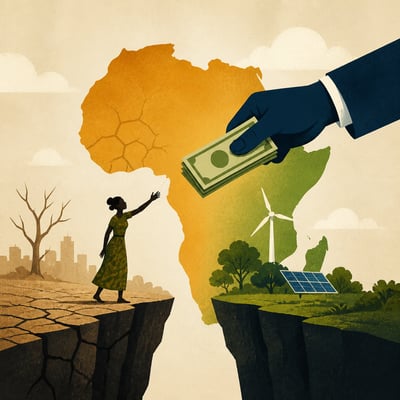
The story has broadened from a general climate-finance gap into a more specific debate over the structure of finance: African actors are now explicitly rejecting debt-heavy and private-capital-centered models in favor of grants, technology transfer, and domestic value creation. It also puts sharper emphasis on energy transition choices, including fossil-fuel dependence, industrialization, and local economic benefits.
- Calls now favor grants, technology transfer, and debt relief.
- Finance models based on private capital and offsets are being challenged.
- Energy-transition priorities include grid modernization and clean cooking.
- Fossil-fuel-revenue dependence is now a central constraint.
- Domestic value creation is newly framed as a climate-finance objective.
05/21/20260 new articles
The story is largely stable, but the framing has sharpened around debt and concessional finance as the key bottlenecks to climate delivery in Africa. It also adds a stronger governance and fairness angle, linking climate finance to who captures value from transition investments.
05/11/2026Topic Formed
Recent climate coverage emphasizes a persistent finance gap: African and Global South governments are pressing for predictable funding to deliver adaptation, mitigation, and just transition plans while international forums reaffirm Paris goals without closing the implementation gap.

 Climate
 Privacy
 Bob Dylan
 Drones
 Data Centers
 AI Governance
 2026 Maine Senate Race