
 Climate
 Privacy
 Bob Dylan
 Drones
 Data Centers
 AI Governance
 2026 Maine Senate Race
Indigenous Consent in Climate Projects
Coverage from Grist, Extreme Temperature Diary- Sunday February 8, and others
Articles
3
Active Days
128
The Topic
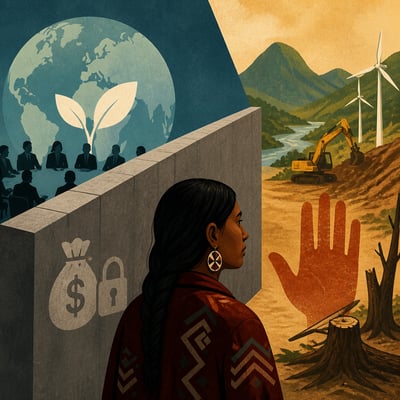
Climate finance and climate projects frequently fail to give Indigenous communities direct funding, enforceable consent, or meaningful decision-making power, despite their role in managing ecosystems and facing climate impacts. Examples span global funding systems, carbon-market conservation in Kenya, renewable infrastructure proposals, and a discontinued geoengineering project. The central concern is that climate action can reproduce displacement and ecological harm unless it respects Indigenous land rights, sovereignty, and community-led stewardship.
First Article: 02/08/26
Latest Article: 06/15/26
Summary
- Indigenous peoples and local communities received less than 1% of global mitigation and adaptation funding between 2011 and 2020, according to a Rainforest Foundation Norway estimate.
- The Green Climate Fund has not accredited an Indigenous organization for direct funding and has lacked a precise way to track Indigenous-specific receipts.
- Land conservation and carbon-credit efforts can conflict with Indigenous land rights, as illustrated by eviction pressure facing the Ogiek people in Kenya’s Mau Forest.
- Free, prior and informed consent is widely recognized as a safeguard, but the articles describe implementation as inconsistent and often too late to influence project decisions.
- Renewable energy and other climate projects can cause harm when they are poorly sited or proceed without meaningful consultation, including concerns around a proposed pumped-hydro site near a Yakama Nation sacred area.
- The articles emphasize community-led conservation, direct finance, enforceable consent, and reuse of disturbed land as ways to align climate action with Indigenous rights.
History
The framing has sharpened: the story now emphasizes enforceable consent and decision-making authority, not just direct funding access, as the core failure in climate projects affecting Indigenous communities. It also adds the 2025 Green Climate Fund evaluation and broadens the geography slightly to the Arctic region while keeping the same underlying conflict.
The story now places stronger emphasis on specific 2026 examples showing how renewable-energy and geoengineering-related projects can still harm Indigenous rights, not just conservation and carbon-market conflicts. It also adds a concrete court-backed land-rights context in Kenya and a new U.S. sacred-site case involving the Yakama Nation.
Featured
Timeline: 128 Days
Hover over any logo to see coverage summary, click for full article.