History
07/23/20260 new articles
The story has broadened from general agrivoltaics experimentation into a more specific, current picture of early commercial deployment and active U.S. research sites. The main emphasis also shifts toward clearer limits: stronger evidence for grazing and specialty crops, but continued uncertainty for large mechanized row-crop systems.
07/22/20261 new articles
The story has broadened from mostly U.S. testing and policy friction into clearer commercial-scale deployment, especially in the Philippines, where a near-200-megawatt project is now part of the narrative. It also shifts from emphasizing general benefits to stressing the design and operational constraints that determine whether agrivoltaics remains agriculturally viable.
- Nearly 200-megawatt agrivoltaic project underway in Batangas, Philippines
- Earlier Philippine trials are informing a larger commercial buildout
- Habitat management is now included as a dual-use land function
- Design constraints are emphasized as critical to maintaining farm productivity
- Higher costs and local permitting differences limit wider adoption
07/20/202610 new articles
The story has broadened from a general agrivoltaics debate into a more evidence-backed, deployment-centered picture with specific research programs, state policy fights, and some expansion into non-crop uses. The current version emphasizes recurring field testing and clearer benefit patterns, while adding new geographic and institutional actors.
- Recurring field projects are now reported in Arizona, Iowa, Virginia, and Michigan.
- Studies cite reduced evaporation and better soil moisture retention.
- State-level definitions and reporting rules are shaping project feasibility.
- Coverage now includes biocrust recovery under solar arrays.
- New actors include Virginia legislators and multiple university research groups.
06/29/20260 new articles
The story shifts from a broad explanation of agrivoltaics to a more grounded, U.S.-regional picture centered on practical farm testing and local acceptance. It also sharpens the constraint side, emphasizing cost, equipment access, and zoning as the main limits on adoption.
06/28/20263 new articles
The story broadens from general agrivoltaics adoption into a more policy-shaped, execution-focused phase, with stronger emphasis on state/local regulation and specific U.S. deployments. The current version also adds new actors and regions, especially California, Arizona, extension services, and Wisconsin's RESET guidance.
05/25/20263 new articles
The story has broadened from a mostly U.S.-centric agrivoltaics trend into a more clearly international and operationally diversified one, with new actors and use cases beyond crop trials. The framing also shifts toward stronger evidence that dual-use solar is becoming a practical land-management strategy, while land-use conflict and permitting remain major constraints.
05/22/20263 new articles
The story has shifted from a generally experimental agrivoltaics trend to a more concrete operating and policy landscape, with specific institutions, developers, and projects now showing broader implementation. The main new emphasis is on execution: real-world project design, grazing operations, and uneven rules determining where dual-use solar can scale.
05/13/2026Topic Formed
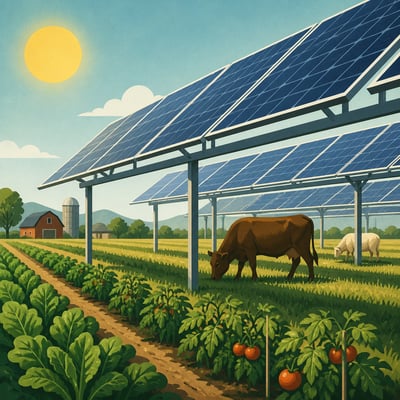
Agrivoltaics is advancing as a practical way to pair solar power with farming, especially where heat and water stress are making crops harder to sustain. Recent reporting emphasizes field trials, farm-scale experiments, and research showing benefits for shade, moisture retention, grazing, and diversified income, alongside persistent limits from zoning, cost, and layout constraints. The signal is fairly coherent and current, with most material pointing to ongoing deployment and evaluation rather than a settled model.

 Climate
 Privacy
 Bob Dylan
 Drones
 Data Centers
 AI Governance
 2026 Maine Senate Race