History
07/31/20260 new articles
The update sharpens the story with a higher-emissions figure for major tech firms and a clearer picture of policy pushback around datacenter siting, water use, and grid impacts. It also reframes China’s approach as a more explicit renewable-hub strategy for new datacenter hubs.
07/30/20261 new articles
The story now adds a clearer policy and geographic split: US datacenter growth is increasingly tied to grid congestion, coal retention and local opposition, while China’s coordinated siting rules and clean-power requirements emerge as a more explicit countermodel. The emissions picture also sharpens, with Microsoft, Amazon and Google’s combined reported emissions rising sharply through March 2026.
- US datacenter demand is contributing to longer grid queues.
- Some coal plants are staying online because of AI datacenter demand.
- China requires designated datacenter hubs to source at least 80% clean electricity.
- Reported combined emissions for Microsoft, Amazon and Google rose sharply through March 2026.
- Local opposition is growing around electricity affordability and water availability.
07/29/20261 new articles
The story now places greater emphasis on actual emissions increases from major tech firms and on utilities extending fossil generation, not just on projected grid and water strain. It also broadens the policy response around cleaner power, efficiency, and reporting as datacenter buildout accelerates.
- Microsoft, Amazon, and Google reported substantially higher emissions.
- Utilities are extending fossil-fuel generation for AI-driven demand.
- Renewables and storage are being integrated into datacenter projects.
- Datacenters account for roughly 6% of electricity use in the UK and US.
- The UK is newly included alongside the US and China.
07/28/20260 new articles
The story has broadened from a general AI-data-center climate and grid issue into a more specific account of operational constraints and regional resource stress, especially water scarcity and local cost impacts in the United States. It also adds clearer policy detail on China’s clean-power requirements for designated data-center hubs.
- Project cancellations and uncertain AI profitability may slow U.S. data-center growth.
- Many planned U.S. data centers are located in drought-affected regions.
- China requires designated data-center hubs to source at least 80% of electricity from clean power.
- Estimation methods now differ on whether to include hardware manufacturing and regional grid emissions.
- Local opposition now includes noise, construction impacts, and household electricity bills.
07/26/20264 new articles
The story has shifted from a broad account of AI datacenters stressing power and water systems to a more specific debate over how fast AI load will grow, how to account for its emissions, and what grid limits will cap expansion. It also adds China’s clean-power deployment model as a new policy contrast.
- Forecasts now emphasize uncertainty over how much AI buildout will materialize.
- Emissions accounting is constrained by missing provider energy disclosures.
- Grid and transmission capacity are now identified as practical bottlenecks.
- China is using renewable procurement rules and dedicated clean-energy hubs.
- PJM Interconnection is newly highlighted as a constrained grid operator.
07/22/2026Topic Formed
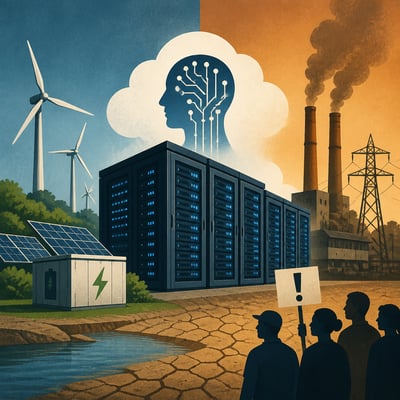
Rapid expansion of AI datacenters is increasing demand for electricity and cooling water across the United States and other major markets. Utilities and technology companies are pursuing a mix of new gas generation, extended fossil-fuel use, renewables, batteries and other power sources, creating tension between digital growth, emissions reduction and grid reliability. Communities are also raising concerns about drought exposure, water withdrawals, pollution, land conversion, noise and higher household electricity costs, while planning and reporting systems often assess projects individually rather than cumulatively.

 Climate
 Privacy
 Bob Dylan
 Drones
 Data Centers
 AI Governance
 2026 Maine Senate Race