
 Climate
 Privacy
 Bob Dylan
 Drones
 Data Centers
 AI Governance
 2026 Maine Senate Race
AI Data Centers Drive Gas Expansion
Coverage from Carbon Brief, WIRED, and others
00/00/0000
Articles
19
Active Days
125
The Topic
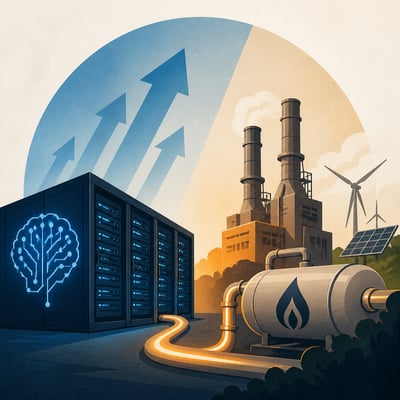
Rapid expansion of AI data centers is increasing electricity demand and prompting technology companies, utilities, and gas producers to develop new natural-gas generation, often directly at or near data-center sites. The trend is most pronounced in the United States and is also emerging in Alberta, where proposed projects could place substantial pressure on electricity systems and water resources. It is widening the gap between annual renewable-energy claims and the physical sources of power used by some facilities, while creating new concerns over emissions, air pollution, and local impacts.
First Article: 03/23/26
Latest Article: 07/25/26
History
The story now frames data-center gas buildout less as a broad power-demand trend and more as a concrete market and policy challenge shaped by interconnection delays, Alberta grid constraints, and corporate renewable-accounting scrutiny. The addition of Alberta electricity limits and RE100-related tension makes the risks feel more specific and operational.
The story now places greater emphasis on the scale of proposed gas buildout and its broader market momentum, adding record global gas-plant orders and a more explicit estimate of potential emissions from US data-center campuses. It also sharpens the framing around uncertainty, noting that many projects are early-stage and that permitted emissions may overstate actual operations.
- Record global orders for new gas plants are tied to US data-center demand.
- Eleven US data-center campuses could emit over 129 million tons annually.
- Meta has funded major gas-power projects for its AI facilities.
- Alberta has received about 20.7 gigawatts of data-center connection requests.
- Many proposed projects remain early-stage, with uncertain actual emissions.
The story has sharpened from a broad mismatch between AI growth and clean-energy pledges into a more concrete account of new gas-buildout activity, especially captive power plants and turbine orders. It also adds a stronger policy and stakeholder dimension, with Meta's RE100 exit and Alberta governments more explicitly encouraging on-site gas generation.
- US data-center growth is triggering new gas-power investment and turbine orders.
- Permitted US AI-campus projects could generate very large greenhouse-gas emissions.
- Meta has left the RE100 initiative.
- Alberta data-center electricity requests may exceed current grid capacity.
- Natural-gas producers and governments are actively promoting AI infrastructure demand.
The story has sharpened from a broad account of AI-driven power demand into a more specific pattern of fast-rising data-center load colliding with gas-backed electricity sourcing, especially around Google, Meta, and Canadian gas supply. The newest emphasis is on the practical constraint—firm power and grid timing—rather than just climate pledges.
- Meta emerges as a recurring major actor in the story.
- Alberta is now a clearer focal region for gas-linked AI power demand.
- Crusoe Energy is identified as a distinct developer actor.
- Local air, water, and community-opposition concerns are now explicitly highlighted.
The story is now framed more explicitly around AI data centers as a major driver of near-term fossil-power buildout and emissions pressure, especially from behind-the-meter gas plants. It also more clearly emphasizes that tech companies’ clean-energy efforts are lagging demand growth, making climate commitments harder to sustain.
The story now places more emphasis on quantified emissions and health impacts from announced gas-powered AI facilities, while also broadening the clean-energy response to include carbon capture alongside renewables, nuclear, geothermal, and storage. It also adds evidence that large tech firms’ electricity use and emissions are rising further than previously described.
The story now puts more emphasis on the scale of gas buildout tied to AI, including behind-the-meter plants built to dodge grid queues, and on the growing public-health scrutiny around those projects. It also adds stronger evidence that AI-related demand is already reshaping gas markets and prompting utilities and producers to frame AI as a long-term load source.
- Global gas-plant orders hit a 25-year high in 2025.
- Behind-the-meter gas plants are being used to bypass interconnection queues.
- Modeled emissions reflect permitted or full-capacity scenarios, not actual operations.
- Google’s electricity use rose 37% in 2025.
- Canadian gas firms are pitching AI data centers as future demand.
The story has sharpened from a general AI power-demand and gas-bridge narrative into one centered on measured emissions growth, especially Scope 3, and on the scale of planned gas-powered data center buildouts. It also adds more explicit clean-firm alternatives and sharper scrutiny of Texas-linked projects.
The story is now framed less as a Texas-specific gas buildout problem and more as a broader clean-firm-power challenge for AI data centers, with explicit attention to 24/7 load matching and the limits of current alternatives. It also newly emphasizes permitting, air pollution, and community opposition as practical obstacles to gas-backed expansion.
The cluster is centered on AI-driven electricity demand pushing hyperscalers toward natural gas-backed power for data centers, especially behind-the-meter or on-site generation in Texas and other U.S. markets. The dominant pattern is a tension between rapid load growth and corporate clean-energy commitments, with wind or other clean additions often presented as partial offsets rather than full substitutes. A secondary but important thread is the search for cleaner firm power, including carbon capture, as a response to grid, permitting, and interconnection constraints.