
 Climate
 Privacy
 Bob Dylan
 Drones
 Data Centers
 AI Governance
 2026 Maine Senate Race
Carbon Capture Projects Face Cost Tests
Coverage from The Narwhal, Canada's National Observer, and others
00/00/0000
Articles
30
Active Days
272
The Topic
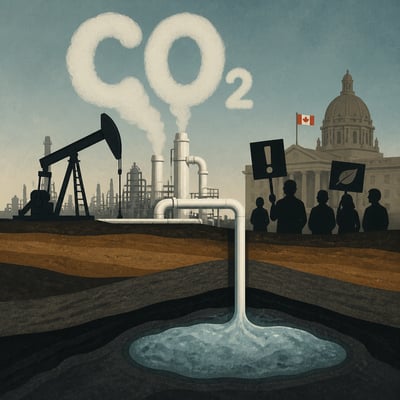
Carbon capture and storage is being advanced as a way to reduce industrial emissions, with Canada’s Pathways project serving as a central test of whether the technology can support Alberta’s oil sands while meeting climate goals. The project’s expected start date, capture volume and cost have worsened from earlier plans, increasing reliance on public incentives and carbon-credit revenues. Across Canada and the United States, proposed facilities also face questions about commercial performance, storage integrity, community consent and whether CCS reduces emissions or enables continued fossil fuel production.
First Article: 10/29/25
Latest Article: 07/27/26
History
The story now places greater emphasis on CCS economics and policy support, while broadening from an Alberta oilsands debate to a wider North American CCS controversy. New attention to U.S. projects and offshore storage adds regulatory and liability uncertainties beyond the original Pathways-centered framing.
The biggest update is that Pathways looks materially smaller, later, and more expensive than before: its first phase is now framed as about 6 million tonnes by 2035, with total costs rising sharply. The story also sharpens around policy support and carbon-market design as the key determinants of whether CCS projects can still pencil out.
- Pathways first phase now targeted at about 6 million tonnes by 2035.
- Longer-term Pathways plans extend to 16 million tonnes.
- Projected Pathways costs now cited at C$20 billion–C$30 billion.
- Alberta carbon-market changes may weaken bio-CCS and waste-to-energy economics.
- Federal and Alberta support now includes operating assistance and compliance credits.
The story shifts from a broad debate over costly, delayed CCS projects to a more specific policy and project-finance picture: Canada’s track record is weaker than expected, Pathways is now explicitly delayed to 2035, and revenue uncertainty from carbon markets has become central. The framing also broadens more clearly to include U.S. and offshore storage proposals, with local-control and long-term monitoring risks now more prominent.
- Canada has captured far less CO2 than earlier projections.
- Alberta oil sands emissions have continued to rise.
- Pathways first phase is now targeted for 2035.
- Carbon markets and fuel-market mechanisms face revenue uncertainty.
- Indiana communities are challenging storage projects over local-control concerns.
The main change is a sharper downgrade in Pathways’ scale and economics: the project is now framed as a much smaller 2035 effort with materially higher costs, while financing still depends on public incentives. The story also broadens the controversy by emphasizing U.S. community and storage concerns alongside the oilsands policy debate.
- Pathways now targets about 6 million tonnes annually by 2035.
- Estimated costs have risen to C$20 billion-C$30 billion.
- Investment tax credits and Clean Fuel Regulation credits remain central to financing.
- U.S. consent, groundwater and liability concerns are newly foregrounded.
- The story now asks whether CCS substitutes for direct emissions cuts.
The biggest change is that Pathways is no longer just a large proposed CCS anchor project: it is now described as delayed, scaled back, and substantially more expensive, sharpening doubts about its economics. The story also shifts toward broader scrutiny of who will bear CCS costs, with stronger emphasis on public support, consumer energy prices, and project safety risks.
- Pathways has been delayed and scaled back from its original capture target.
- Pathways faces substantially higher cost estimates.
- Public support may flow through consumer energy prices.
- Offshore storage is attracting oil and gas developers.
- Regulators and investors lack extensive long-term commercial operating data.
The story has shifted from a broad contest over CCS support and criticism to a more specific focus on project economics and regulatory design. Alberta’s Pathways project and proposed credit/accounting changes now drive the narrative, while U.S. opposition and offshore-storage concerns add new evidence that CCS faces both financial and liability constraints.
- Pathways Alliance targets about 6 million tonnes of annual capture by 2035.
- Alberta pricing changes could weaken revenues for Varme Energy and Torchlight.
- Draft Alberta protocol would support shared transport and storage hubs.
- Indiana residents are challenging an ethanol-linked storage project.
- Offshore storage concerns now include leak detection and long-term monitoring.
The story has broadened from Alberta-Pathways negotiations into a wider CCS policy and project landscape. It now emphasizes active rulemaking, funding, and project execution in Canada, while adding U.S. cases that sharpen concerns about community resistance and environmental risks.
- Alberta is expanding CCS measurement, storage, and crediting rules.
- U.S. CCS cases add local resistance near farmland and drinking water.
- The Andersons Renewables, Google, Inter Pipeline, and Entropy appear as new actors.
- Net-zero goals remain, but near-term regulations are being softened or traded.
- CCS is now framed more openly as supporting fossil-fuel viability.
The story has narrowed and sharpened around the Pathways Alliance CCS proposal as an actively negotiated political package, rather than a broad set of carbon-policy and methane initiatives. The newest wrinkle is that reported capture targets and timelines may be scaling back, strengthening doubts about whether the project can be delivered as advertised.
- Pathways Alliance CCS is still being negotiated, not built.
- The CCS proposal is linked to pipeline concessions and oilsands growth.
- Reported capture targets and timelines are shifting downward.
- Federal-Alberta talks now center on subsidies and tax credits for CCS.
The story has broadened from carbon capture policy alone to a denser package that now explicitly includes methane mitigation funding and deployment tools alongside tighter carbon pricing and CCUS rulemaking. The frame also shifts from a mainly CCS infrastructure debate to a more fragmented implementation fight over feasibility, credibility, and whether these measures can deliver meaningful net emissions cuts.
The story has moved from a general CCS policy push to a more concrete Alberta-Canada regulatory package, with new rules and accounting pathways intended to make large projects executable. The latest version also adds a sharper climate-efficacy challenge, saying modeling of the agreement implies limited net benefit because higher oil output offsets much of the gains.
- Alberta is updating CCUS accounting and storage rules.
- New MRV requirements are being added.
- Broader eligible storage formations are now included.
- A new removal-credit pathway covers DAC and BECCS.
- Modeling suggests higher oil output offsets much of the climate benefit.
The story now centers more explicitly on carbon-pricing reforms and regulatory support as the mechanism for pushing CCS forward, rather than just broad government backing. It also adds a more concrete implementation-and-risk picture, with longer-term infrastructure planning, cost uncertainty, and concerns about whether projects will hit capture targets.
Alberta and federal governments are advancing major carbon capture projects tied to oil sands emissions, while communities, critics, and some analysts question cost, safety, and whether CCS is a durable climate solution.