
 Climate
 Privacy
 Bob Dylan
 Drones
 Data Centers
 AI Governance
 2026 Maine Senate Race
AMOC Collapse Risk Intensifies
Coverage from The Guardian, Yale E360, and others
Articles
31
Active Days
335
The Topic
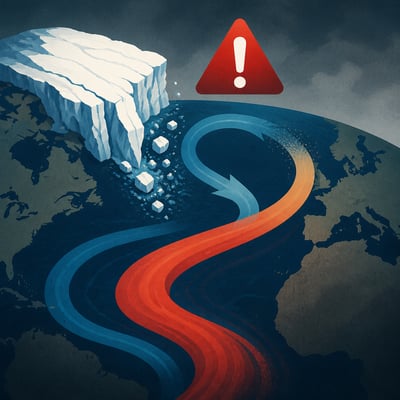
Recent studies and reporting increasingly treat AMOC weakening as a serious near-term risk rather than a distant possibility. The dominant pattern is model-based evidence linking warming and Greenland meltwater to a higher chance of tipping behavior, with possible consequences for European weather, rainfall shifts, and sea level. A smaller but important thread explores downstream carbon-cycle feedbacks and uncertainty in model thresholds.
First Article: 08/28/25
Latest Article: 07/28/26
Summary
- AMOC collapse risk has moved from speculative framing to repeated model-based warnings across multiple recent studies.
- Greenland ice melt and ocean warming are the most consistent physical drivers behind the weakening signal.
- Several studies now estimate non-trivial probabilities of collapse or committed collapse within decades to this century, depending on emissions and melt assumptions.
- Expected impacts repeatedly include stronger disruption to European climate, especially winter conditions, rainfall patterns, and Atlantic sea level rise.
- Some reporting adds a second-order carbon-cycle concern: AMOC shutdown could alter Southern Ocean mixing and release additional stored carbon.
- Adaptation and risk planning appear uneven, with some governments still not explicitly incorporating AMOC shutdown into formal planning.
- The topic remains scientifically active and somewhat fragmented because model thresholds, timing, and collapse probabilities vary across studies.
History
The story has shifted from broad concern about a weakening AMOC to a more urgent framing that recent studies see collapse risk as a near-term possibility, not just a distant one. The new emphasis is on model-based probabilities, Greenland meltwater, and planning gaps rather than on general debate over whether weakening is occurring.
The framing has become more specific and slightly broader: the story now emphasizes quantitative projections of substantial AMOC decline by 2100, plus direct measurements, paleoclimate evidence, and a growing planning response from authorities. It also newly incorporates West Antarctic melt as part of the freshwater-driven debate.
Featured
Timeline: 335 Days
Hover over any logo to see coverage summary, click for full article.