History
07/20/20267 new articles
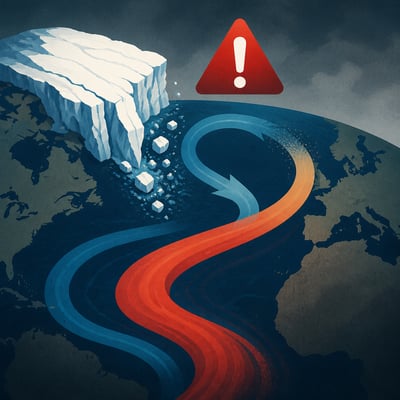
The story has shifted from broad concern about a weakening AMOC to a more urgent framing that recent studies see collapse risk as a near-term possibility, not just a distant one. The new emphasis is on model-based probabilities, Greenland meltwater, and planning gaps rather than on general debate over whether weakening is occurring.
- Recent studies increasingly treat AMOC collapse as a near-term risk.
- Several studies estimate non-trivial collapse probabilities within decades.
- AMOC shutdown may affect Southern Ocean mixing and carbon release.
- Some governments still do not formally include AMOC shutdown in planning.
- Recent high-salience studies were published in 2026.
06/29/20260 new articles
The framing has become more specific and slightly broader: the story now emphasizes quantitative projections of substantial AMOC decline by 2100, plus direct measurements, paleoclimate evidence, and a growing planning response from authorities. It also newly incorporates West Antarctic melt as part of the freshwater-driven debate.
06/28/20263 new articles
The story has sharpened from a broad weakening-risk narrative into a more explicit tipping-threshold frame, with stronger emphasis on observed North Atlantic cooling and freshwater forcing as the likely drivers. It also adds more concrete institutional monitoring context through named observing arrays and agencies, while the core uncertainty remains timing and collapse likelihood.
06/17/20263 new articles
The story has shifted from broad concern about AMOC weakening to a more specific and stronger framing: current evidence is now described as converging on higher tipping-risk estimates, with uncertainty centered on timing and threshold rather than on whether change is occurring.
06/12/20263 new articles
The story has shifted from broad concern about possible AMOC weakening to a more evidence-heavy framing, with stronger emphasis on observational tests and paleoclimate validation. The main uncertainty remains intact, but the discussion now leans more explicitly toward adaptation planning in Europe and Iceland.
05/18/2026Topic Formed
New research and commentary repeatedly point to a weakening Atlantic Meridional Overturning Circulation, with estimates of substantial slowdown by 2100 and disagreement over how close the system is to a tipping point. The strongest signal is not a confirmed collapse, but rising concern about nonlinear change, regional climate disruption, and the need for adaptation and emissions cuts.

 Climate
 Privacy
 Bob Dylan
 Drones
 Data Centers
 AI Governance
 2026 Maine Senate Race