
 Climate
 Privacy
 Bob Dylan
 Drones
 Data Centers
 AI Governance
 2026 Maine Senate Race
Last Update: 08/01/2026 at 5:00 PM EST
Antarctic Ice Loss And Sea-Level Risk
Coverage from Inside Climate News, Nature, and others
Articles
5
Active Days
1087
The Topic
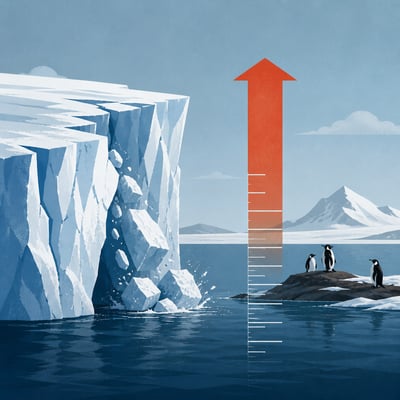
Recent work extends Antarctic ice and sea-level research into longer time horizons, with projections of ice loss, land exposure, ecosystem disruption, and governance pressure under different emissions pathways. Earlier satellite records also reinforce that sea-level rise has tracked long-term forecasts closely while ice-sheet melt has contributed more than expected.
First Article: 07/21/23
Latest Article: 07/11/26
Summary
- Antarctic projections now span both near-term 2100 outcomes and multi-century changes through 2300.
- Emissions pathway remains the main driver of projected ice loss, sea-level contribution, and ecosystem stress.
- Observed sea-level rise has broadly matched older forecasts, but ice-sheet melt has contributed more than early models anticipated.
- The Antarctic Peninsula stands out as a sensitive region for warming, sea-ice decline, and ice-shelf collapse risk.
- Long-run ice retreat may expose new land areas, creating added pressure on Antarctic territorial claims and treaty governance.
- The evidence base is still model-heavy, with uncertainty concentrated in climate trajectories, ice-sheet response, and regional impacts.
History
This topic is new, but as new articles are added to it this area will summarize shifts, changes and expansions of the issues.
Featured
07-11-2026
UC Boulder scientist Ted Scambos links unusually low Antarctic Peninsula sea ice to warm winds and ocean water and warns of long-term glacier-driven sea-level rise risks.
12-05-2025
Researchers used CMIP6 GCMs and ISMIP6-calibrated ice-sheet models in the 2020s to project Antarctic mass loss and sea-level contribution through 2300 across emission scenarios in Antarctica.
02-20-2026
Scientists from Newcastle University and the British Antarctic Survey modeled 2100 outcomes for the Antarctic Peninsula, finding higher emissions will accelerate ocean warming, ice loss, and ecosystem collapse.
Timeline: 1087 Days
Hover over any logo to see coverage summary, click for full article.
Additional Articles
⭐⭐⭐⭐⭐
Erica Lucas and colleagues at the University of California, Santa Cruz project larger ice-free Antarctica land exposure by 2300 using glacial isostatic adjustment, with potential governance impacts for Argentina, Chile, and the United Kingdom.
⭐⭐⭐
Tulane and collaborators report in 2025 that 30-year satellite altimetry confirms mid-1990s global sea-level projections while showing larger-than-expected ice-sheet melt, affecting regional risk assessments in places like south Louisiana.