
 Climate
 Privacy
 Bob Dylan
 Drones
 Data Centers
 AI Governance
 2026 Maine Senate Race
Antarctica’s Warm Oceans Raise Sea Risks
Coverage from Inside Climate News, The Conversation, and others
00/00/0000
Articles
45
Active Days
121
The Topic
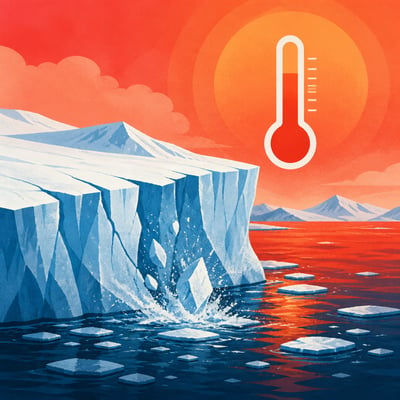
An unusually large area of Antarctic winter sea ice failed to form along the western Antarctic Peninsula, driven by warm air and ocean conditions. The immediate sea-ice anomaly is part of a broader concern that warm deep water is melting glaciers from below, particularly in West Antarctica, while snowfall temporarily offsets some ice losses elsewhere. Thwaites Glacier remains a major uncertainty for the timing and scale of future sea-level rise, which is expected to vary substantially by region.
First Article: 03/18/26
Latest Article: 07/16/26
History
The update mainly tightens the framing and adds a clearer timestamp, while keeping the core scientific story unchanged. It also slightly shifts emphasis from a broad sea-ice anomaly to ongoing glacier melt and uneven sea-level impacts on island regions.
The story now puts more emphasis on the broader glacier-melt mechanism than on the sea-ice anomaly alone, highlighting deep warm water reaching glacier undersides and accelerating ice discharge. It also sharpens the framing of future sea-level impacts, stressing uneven effects on low-lying Indian and Pacific island communities.
The story is slightly reframed from an exceptional Antarctic sea-ice anomaly toward a clearer distinction between the immediate ice-surface deficit and the longer-term glacier and sea-level risks. The updated version also softens some specifics by emphasizing uncertainty about timing and scale rather than highlighting a near-term collapse risk.
The story has sharpened from broad Antarctic warming and sea-ice decline into a specific June 2026 west-coast sea-ice deficit and a clearer long-term sea-level threat from warm water melting glaciers from below. It also adds a more explicit geographic distribution of impacts, with some tropical islands potentially facing above-average sea-level rise.
- June western Antarctic sea-ice deficit roughly the size of France
- Warm South Pacific air and unusually warm ocean water blocked ice formation
- East Antarctic snowfall partly offset recent Antarctic ice losses
- Tropical Indian and Pacific islands may face about 30% above-average sea-level rise
The story has broadened from a sea-ice decline mechanism narrative into a wider Antarctic cryosphere instability story, adding regional warming contrasts, ice-shelf and glacier risk, and model-performance concerns. It also now emphasizes specific 2024 extreme heat events and a weaker, more local geology-based alternative explanation.
- 2024 winter heatwave is highlighted as a short-term extreme.
- Ice-shelf thinning and glacier melt risk are now part of the story.
- West Antarctica and the Antarctic Peninsula are singled out as hotter, higher-risk regions.
- CMIP6 models are specifically cited as missing observed Antarctic change.
- A local geothermal heat contribution is mentioned as a weaker alternative explanation.
The framing has narrowed from a broader Antarctic climate story to a more focused mechanism-level account of the post-2015 sea-ice collapse. The new version adds a sharper feedback interpretation and emphasizes that current models still miss key Southern Ocean mixing processes.
The story has broadened from a sea-ice decline narrative into a wider Antarctic instability picture that now explicitly includes glacier behavior and polar weather impacts. The latest material also adds more specific mechanisms and sites, while strengthening the case that current models lag behind observed change.
- Glacier discharge and sliding are newly tied to Antarctic warming.
- Storm-driven mixing is identified as a specific sea-ice loss mechanism.
- Precipitation-driven surface freshening is now cited as a feedback factor.
- Ecological impacts extend to benthic and marine community structure.
- Hokkaido University fieldwork at Langhovde Glacier adds new evidence.
The story has broadened from a mostly ice-and-ocean decline narrative into a more integrated climate-impact picture, with new emphasis on extreme Antarctic weather, fieldwork disruption, and a reinforcing feedback loop that may be undercaptured by models. At the same time, a minority explanation about local geothermal or volcanic heat has become more explicit, though it remains secondary.
The framing has shifted from a broadly ongoing Antarctic sea-ice decline to a sharper post-2015 collapse that is now treated as a persistent regime rather than a temporary anomaly. The updated coverage also places greater weight on downstream impacts and on model shortcomings in capturing Antarctic mixing and regional variability.
- Sharp post-2015 sea-ice collapse is now the dominant framing.
- Low-sea-ice conditions are increasingly treated as persistent since about 2018.
- Downstream risks now include glacier discharge, carbon storage, and ecosystem stress.
- Models are said to miss key Antarctic mixing and regional variability processes.
- Geothermal and volcanic influences are now clearly secondary.
The cluster is currently centered on Antarctic sea-ice decline and related Southern Ocean heat dynamics, with multiple studies converging on wind-driven upwelling, weakened stratification, and deep-ocean heat reaching the surface or ice shelf margins. A second current thread concerns Antarctic temperature extremes and regional warming variability, including attribution of a severe East Antarctic winter heatwave to altered circulation and human influence. The cluster is scientifically cohesive but not perfectly unified because one article introduces geothermal/volcanic attribution as an alternative local driver.