
 Climate
 Privacy
 Bob Dylan
 Drones
 Data Centers
 AI Governance
 2026 Maine Senate Race
Australia’s EV Shift Cuts Emissions
Coverage from The Guardian, The Sydney Morning Herald, and others
Articles
8
Active Days
98
The Topic
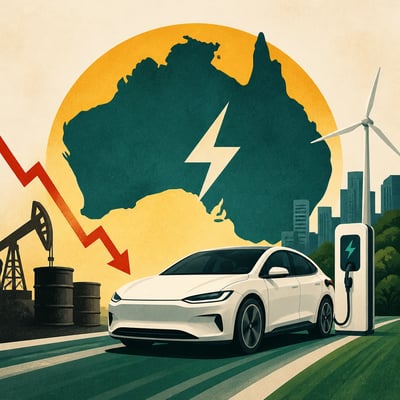
Australia’s electric vehicle market is expanding and is beginning to contribute to lower transport emissions, but EVs still represent a small share of the national vehicle fleet and new-car sales. Fuel-price volatility and reliance on imported oil are strengthening the case for electrification, while government policy remains contested over incentives, taxation, charging infrastructure and vehicle standards. Meeting Australia’s emissions goals will require much faster uptake alongside cleaner electricity and broader transport changes.
First Article: 02/24/26
Latest Article: 06/01/26
Summary
- EVs reached roughly 13–15% of new-car sales in late 2025 and March 2026, but accounted for only about 2% of Australia’s vehicle fleet.
- Transport emissions fell 0.4% in the year to September 2025, while economy-wide emissions fell about 1.9–2%, with EVs and renewable electricity contributing to the decline.
- Replacing petrol vehicles with EVs would shift energy demand from imported fuel toward largely domestic electricity and reduce exposure to global oil-price shocks.
- Fuel-price increases are renewing pressure to expand EV incentives, improve charging access and support electric trucks and other forms of freight electrification.
- Policy debate includes the future of EV leasing subsidies, fuel-tax credits for diesel users, possible road-user charges and tighter vehicle-efficiency standards.
- Australia’s current adoption rate is widely described as insufficient to meet longer-term emissions goals, which would require a substantial increase in clean-vehicle sales.
History
The story is now framed more explicitly around policy debate and implementation choices needed to accelerate EV uptake, rather than mainly on early emissions gains and fuel-replacement potential. It also adds stronger emphasis on fuel-price shocks, road-user charges, and vehicle-efficiency standards as part of the policy mix.
The story broadens from EV adoption alone to a wider electrification agenda that includes rooftop solar, batteries and renewable electricity. It also sharpens the policy debate around preserving incentives versus redirecting fossil-fuel support toward electrification.
Featured
Timeline: 98 Days
Hover over any logo to see coverage summary, click for full article.