
Last Update: 06/03/2026 at 4:25 PM EST
Canada Emissions Gap And Policy Rollback
Coverage from Canadian Climate Institute, Canada, and others
Articles
8
Latest Article
02/28
Active Days
75
Executive Summary
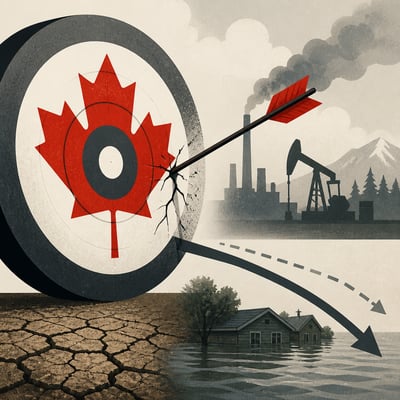
Canada remains off track for its 2030 climate target, with independent assessments projecting emissions cuts far below goal after recent policy rollbacks. The dominant pattern is a gap between formal commitments and the few policies now expected to do most of the remaining work, especially industrial carbon pricing, methane rules, and electricity decarbonization.
Key Points
- Independent assessments consistently place Canada well short of its 2030 emissions target, with projections around 18-22% below 2005 levels instead of 40-45%.
- Recent policy changes, especially the end of consumer carbon pricing and the expiration of the EV sales mandate, are repeatedly cited as reasons the emissions path has weakened.
- Industrial carbon pricing, methane regulation, and electricity-sector decarbonization are the main measures still expected to close much of the gap.
- Federal and provincial coordination remains a recurring constraint, with policy effectiveness depending on implementation outside Ottawa as much as on national targets.
- The cluster mixes mitigation policy with some adaptation evidence, including flood damage and winter tourism risks, but mitigation policy dominates the signal.
- A second, smaller thread tracks climate-governance and monitoring issues, including emissions projections, uncertainty, and data gaps in environmental monitoring.
- The topic is coherent and moderately dense: most items reinforce the same policy gap, though a few opinion-style pieces add broader climate framing rather than new evidence.
Featured Article
The Canadian Climate Institute reported on Feb. 13 in Ottawa that Canada is off track for its 2030 emissions target, citing policy rollbacks and economic risks to regions such as Whistler, British Columbia.
Coverage Timeline: 75 Days
Hover over any logo to see coverage summary, click for full article.
Additional Articles
⭐⭐⭐⭐⭐⭐⭐⭐
Canada projects emissions declines by 2035 under WM and WAM, driven by electrification, policy measures, and nature-based removals.
⭐⭐⭐⭐⭐
The Canadian Climate Institute says Canada is off course for its 2030 emissions target and urges stronger federal industrial carbon pricing and provincial cooperation in 2025 in Canada.
The Canadian Climate Institute released a Feb. 13 assessment in Ottawa finding Canada off track for 2030 emissions targets after policy reversals that weaken carbon pricing and programs.
⭐⭐⭐
Canada faces off track climate targets as independent analyses show current policies will not meet 2026 interim goals, 2030 Paris commitments, or 2050 net zero.
⭐️⭐️
Canadian Climate Institute warns Canada will miss emissions targets while the US EPA revoked the 2009 Endangerment Finding, affecting North American climate governance.
Canadians confront climate change as Paris Agreement commitments persist amid fossil fuel subsidies.
Researchers and policymakers emphasize immediate policy action and funding shifts to reduce emissions and strengthen resilience in Canada and globally.