History
07/24/20260 new articles
The story is reframed less as a climate-driven transition and more as a resilience-and-competitiveness response to fossil-fuel volatility. The current version also places greater emphasis on climate-resilient grid planning and the specific demand pressures from data centers and electrification.
07/23/20260 new articles
The story shifts from mainly a resilience-and-grid-reliability narrative to a broader competition story, where energy shocks are also accelerating electrification while intensifying the race over clean-technology manufacturing and supply chains. It now places China, India, the EU, and the U.S. more centrally as industrial and geopolitical actors, not just power-system adapters.
- Clean-energy competition is now framed as geopolitical and industrial, not just operational.
- China is identified as the leading clean-technology manufacturer and exporter.
- Data centers are adding to electricity demand growth.
- India, the EU, and the U.S. are pursuing domestic clean-tech supply chains.
- Climate-informed planning can materially reduce projected grid shortfalls.
07/23/20263 new articles
The story has shifted from a broad resilience-and-affordability case for electrification to a more operationally specific one: energy security, weather stress, and grid reliability now dominate the framing. The current version also adds a clearer geopolitical catalyst, with Strait of Hormuz risk and extreme-weather adaptation front and center.
07/01/20263 new articles
The story has broadened from a mostly renewables-and-grid resilience narrative into a wider energy-security and electrification thesis. It now puts more weight on execution constraints, industrial supply chains, and clean-energy manufacturing capacity—especially China—as essential to scaling the transition.
- Rising electricity demand is now a stated driver of the transition.
- EVs are more central as a demand-shifting technology.
- Permitting and interconnection are newly highlighted constraints.
- Clean-energy manufacturing strength, especially in China, is a new theme.
- Forecasts now emphasize a longer transition with fossil fuels persisting.
05/22/20264 new articles
The story is now more explicitly framed around acute fuel-shock triggers, especially Middle East and Strait of Hormuz disruptions, and links that urgency to practical energy-security responses. It also broadens the set of concrete examples while emphasizing affordability and execution over climate-only messaging.
05/17/2026Topic Formed
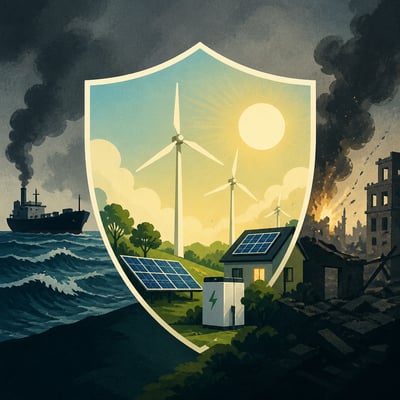
Recent coverage consistently shows renewable power, batteries, and electrification being treated as practical defenses against oil and gas shocks. Countries with stronger clean-energy systems are described as more resilient to price spikes, while grid upgrades and storage remain essential for scale.

 Climate
 Privacy
 Bob Dylan
 Drones
 Data Centers
 AI Governance
 2026 Maine Senate Race