History
07/23/20260 new articles
The update sharpens the climate-loss story by adding new specific mechanisms and risks: warmer temperatures, rainfall change, land-use change and habitat barriers are now emphasized as interacting constraints on movement and survival. It also broadens the plant finding from projected habitat loss to include current extinction risk among evolutionarily distinctive flowering plants.
07/22/20263 new articles
The story now includes a new global observed-extinction analysis, shifting it from mostly projected habitat-loss risk to evidence that climate change is already causing local extinctions, especially in temperate regions. It also broadens to animal groups and tropical mountain systems, adding a clearer contrast between observed losses and future habitat-loss projections.
- Global analysis of more than 5,100 species found higher local extinction rates in temperate regions.
- Observed local extinctions are now linked to faster warming than in the tropics.
- Tropical mountain wildlife faces added risk from limited higher-elevation habitat.
- High-emissions scenarios greatly increase projected range loss for tropical mountain species.
06/29/20260 new articles
The story has shifted from a broad climate-biodiversity warning to a more specific plant-focused finding: climate change is not only shrinking habitat but also removing the full set of conditions plants need to persist. The updated framing also broadens the conservation implication from relocation alone to emissions cuts, connectivity, and protecting climate refuges.
06/22/20264 new articles
The story has broadened from projected plant habitat loss to a wider biodiversity-climate risk picture, with stronger evidence for real-world local extinctions and an added wildfire dimension. It also reframes the geography of highest risk, emphasizing temperate regions more than the prior version did.
- Temperate ecosystems show stronger local extinction signals than tropical ecosystems.
- Wildfire is emerging as a biodiversity threat through longer fire seasons and larger burned areas.
- South America appears as a repeated high-risk region.
- Some high-latitude regions are now highlighted as vulnerable.
- Recent surveys are providing real-world confirmation of climate-related local extinction.
06/11/20263 new articles
The story has sharpened from a broad climate-biodiversity risk pattern into a more specific plant-habitat-loss finding: habitat disappearance is now framed as the main extinction driver, and assisted migration is explicitly judged insufficient on its own. The current version also adds named research actors and source institutions behind the studies.
05/17/2026Topic Formed
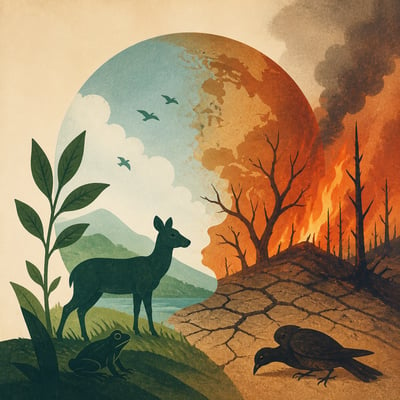
Recent climate research points to substantial plant habitat loss, constrained range shifts, and rising extinction risk across multiple regions. A parallel wildfire-biodiversity line of research shows climate change is also increasing exposure for vulnerable species, with uneven regional impacts and stronger mitigation lowering risk.

 Climate
 Privacy
 Bob Dylan
 Drones
 Data Centers
 AI Governance
 2026 Maine Senate Race