
 Climate
 Privacy
 Bob Dylan
 Drones
 Data Centers
 AI Governance
 2026 Maine Senate Race
Last Update: 08/01/2026 at 11:00 AM EST
Climate-Driven Dust And Drought Risks
Coverage from EurekAlert!, POLITICO, and others
Articles
9
Active Days
1438
The Topic
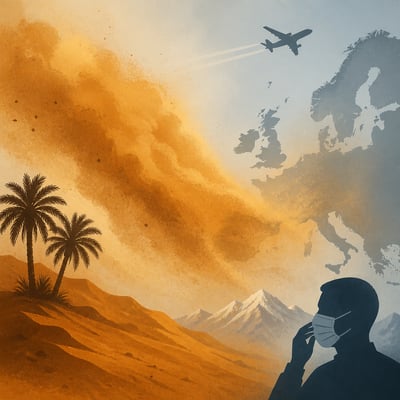
Recent coverage tracks climate-linked dust, drought, and heat hazards affecting Europe and parts of the western United States. The strongest signal is rising Saharan dust exposure in Europe, alongside worsening agricultural, health, and water stress.
First Article: 08/08/22
Latest Article: 07/15/26
Summary
- Saharan dust transport to Europe is becoming a clearer and better-measured climate risk, with higher concentrations reported especially in southern Europe.
- Dust events are linked to worse air quality, more respiratory and cardiovascular harm, and added visibility, transport, and solar-generation impacts.
- European drought and heat stress continue to strain water supplies, crop production, inland transport, and energy systems.
- Agricultural adaptation is shifting toward water management, crop changes, and other farm-level responses, but climate pressure is still intensifying faster than adaptation capacity in many places.
- Food insecurity and worker exposure are increasingly treated as climate-health issues, not only low-income-country concerns.
- Forecast-based drought and dust narratives remain important in the U.S. northern Plains, where warming and El Niño can amplify near-term risk.
- The topic is relatively coherent, but it mixes observed impacts, model-based projections, and scenario-driven forecasts.
History
The story broadened from a mostly Europe-centered climate impacts narrative into a clearer, better-measured dust-risk story that now also includes forecast concern for the U.S. northern Plains. It also adds a stronger emphasis on measurable dust exposure and on adaptation gaps in agriculture and infrastructure.
Featured
07-15-2026
Paul Scherrer Institute researchers used AI and multi-site measurements to map rising Sahara desert dust concentrations across Europe, with largest increases in southern regions.
04-22-2026
Lancet Countdown Europe briefing in 2020s reports climate change-driven pollen, food insecurity, and mosquito-borne disease risks across Europe amid limited policy engagement.
05-06-2026
UN Food and Agriculture Organization and World Meteorological Organization warnings link extreme heat to larger working-hour losses and rising food insecurity risk in Europe.
Timeline: 1438 Days
Hover over any logo to see coverage summary, click for full article.
Additional Articles
⭐⭐⭐⭐⭐
AccuWeather warns that deep drought plus a strong El Niño could intensify heat and dust-storm risks across the northern U.S. Plains in the next few years.
Warming-driven Saharan dust transport is increasing European air-quality, health, snow, and infrastructure impacts, with forecasts enabling up to 15-day public health alerts.
⭐⭐⭐
European governments and utilities in summer 2022 declared drought emergencies and water restrictions across France, Spain, Italy, Germany and neighboring states amid record low rainfall and high temperatures.
Saharan dust transport to Europe is linked to warming-driven desertification, increasing PM10 health impacts and snow-melt effects while forecasting and early warnings support preparedness.
EU research finds climate change is a primary driver of agricultural adaptation as drought, heatwaves, and water scarcity intensify across European farming regions.
Researchers at the University of Illinois Urbana-Champaign and Michigan State University surveyed Michigan corn and soybean farmers in a risk-preference study tied to climate uncertainty.