
Last Update: 08/01/2026 at 12:00 PM EST

Climate Shocks Raise Health Risks

Coverage from The Guardian, NDTV, and others

Articles

17

Active Days

205

The Topic
Climate Shocks Raise Health Risks topic image

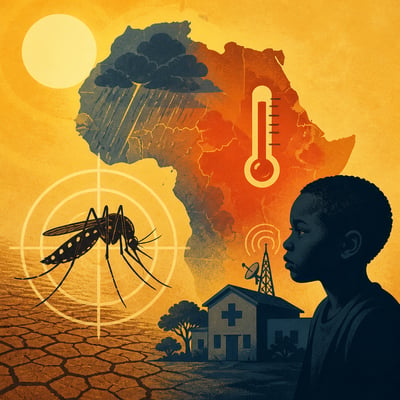
Climate change and climate-related shocks are affecting health through changing disease conditions, disrupted disease-control systems, flooding, displacement, and psychological trauma. In India, dengue transmission is appearing beyond the traditional monsoon season, while African malaria risks are linked increasingly to extreme-weather disruption of treatment, housing, surveillance, and vector control. Projections for Cryptosporidium show that impacts will vary by location, and flooding in Nigeria illustrates the immediate mental-health and livelihood consequences of climate hazards.

First Article: 01/01/26

Latest Article: 07/24/26

Summary

  • Dengue infections in India are being detected earlier and outside the traditional monsoon season as warmer temperatures, erratic rainfall, and urban water storage support mosquito survival and breeding.
  • African malaria projections indicate that extreme-weather disruption to treatment access, housing, surveillance, and vector control may create a larger near-term burden than direct changes in ecological suitability.
  • Climate effects on Cryptosporidium are geographically uneven, with projected declines in some African locations and increased transmission where precipitation rises.
  • Flooding in Lagos is leaving survivors with persistent fear and trauma while damaging homes, farms, livestock, and small businesses.
  • Climate-sensitive health risks are interacting with gaps in mental-health care, clean water, sanitation, surveillance, and resilient health infrastructure.
  • Prevention efforts include vector control, early-warning systems, stronger surveillance, clean-water access, and dengue vaccine development, but no single intervention addresses the full risk.

History

07/22/2026

The story now frames climate-health impacts more broadly as disruption to disease-control systems and livelihood security, not just shifting infection timing and flood-related distress. It also adds a sharper emphasis on uneven Cryptosporidium outcomes and on practical prevention tools like early-warning systems and dengue vaccine development.

07/22/2026

The story now places more weight on specific, quantified projections and a broader set of climate-sensitive diseases, not just malaria and dengue. It also adds concrete evidence of psychological harm after flooding and frames adaptation as a package of health-system responses.

Full History

Featured

Timeline: 205 Days

Jan 1Feb 12Mar 26Apr 23Jun 4Jul 16

Additional Articles

⭐⭐⭐⭐⭐⭐⭐⭐

Nature / Anopheles gambiae01-28-2026
Researchers project malaria cases and deaths rise through 2050 due to extreme weather disruptions to health systems in Africa.

⭐⭐⭐⭐⭐

Nature / Janey Messina and Margaret Carrel03-03-2026
Researchers warn that climate variability and extreme weather threaten malaria control in Africa in the near term.
The Conversation02-08-2026
Hydroclimate scientists project many African regions will experience near-permanent heatwaves by 2065-2100, driven by global emissions and local land-use change across West, East and Southern Africa.
Forbes / John Drake05-14-2026
CDC Emerging Infectious Diseases documented a seven-week dengue transmission chain in Los Angeles County in fall 2024 as climate-driven mosquito suitability enabled local spread from traveler introductions.
Met Office / Dr Matt Palmer01-01-2026
Researchers warn that extreme weather linked to climate change will drive malaria cases and deaths across Africa by 2050.
Stanford Woods Institute for the Environment03-17-2026
Researchers in Peru and the United States report climate-linked warmer, wetter conditions increased dengue epidemic risk after a 2023 cyclone and El Nino.
medRxiv07-08-2026
A 37-participant digital storytelling study across Mozambique, Burkina Faso, South Africa, and Kenya links recurrent floods and cyclones to cumulative mental health distress.
SpringerLink03-31-2026
Malaria control programmes in Chad, Côte d'Ivoire, the Democratic Republic of the Congo, Madagascar, Rwanda, and Senegal report climate-driven changes to rainfall, flooding, and transmission seasons.
DNE Africa / Mohammed El-Said01-31-2026
Researchers warn that climate driven disruptions in Africa could raise malaria cases and deaths by mid century.

⭐⭐⭐

Türkiye Today06-08-2026
Southern Africa health officials reported early-2026 malaria case increases driven by warmer temperatures and heavier rains tied to climate conditions and El Nino, straining vaccine and outreach delivery.
Center for Infectious Disease Research and Policy06-23-2026
Researchers project 2055 Cryptosporidium child diarrhea risks will fall in Siaya County and Bamako but rise in Basse as temperature and precipitation patterns change.
Center for Infectious Disease Research and Policy07-22-2026
Georgetown University researchers synthesized 65 dengue studies from 2020 to 2024, finding warming and urbanization increase transmission risk.
Climate Depot07-24-2026
Beth Carlton and University of Colorado Anschutz researchers report climate-driven warming and extreme weather shift waterborne disease patterns and complicate outbreak control in the United States.
Discover Wildlife04-01-2026
A historical account links UK malaria outbreaks to mosquito ecology and Plasmodium temperature needs, suggesting warming could change vector-borne risk by region.