
 Climate
 Privacy
 Bob Dylan
 Drones
 Data Centers
 AI Governance
 2026 Maine Senate Race
Climate Shifts Infectious Disease Risks
Coverage from EurekAlert!, The Conversation, and others
Articles
20
Active Days
82
The Topic
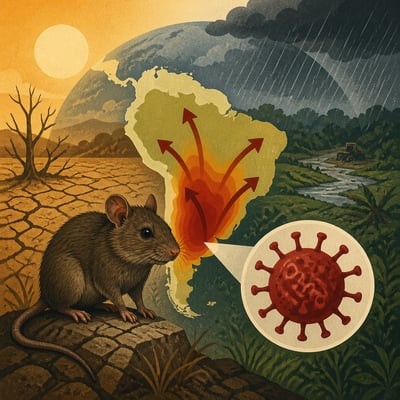
Research and public health assessments are examining how warming, altered rainfall, drought, and extreme weather may shift infectious disease transmission. Evidence and modeling point to changing hantavirus spillover conditions, wider potential ranges for chikungunya vectors, and altered influenza seasonality, while experts emphasize that climate interacts with land use, human behavior, mobility, and health-system capacity. The dominant response is a call for stronger surveillance, attribution research, clinical readiness, and cross-sector coordination before risks become established in new areas.
First Article: 05/04/26
Latest Article: 07/24/26
Summary
- Changing temperature, rainfall, drought, and extreme weather can alter the habitats and behavior of disease vectors, reservoirs, and hosts.
- Hantavirus risks are receiving renewed attention in Argentina and Africa, where rodent ecology, limited surveillance, and human-wildlife contact complicate detection.
- Climate projections identify potential future chikungunya risk zones in parts of Europe, North America, and East Asia as mosquito ranges and viral development conditions change.
- Influenza transmission may shift differently by latitude, with some colder regions seeing milder seasons while some tropical regions face stronger or differently timed outbreaks.
- Climate is a contributing factor rather than a standalone explanation; land-use change, mobility, vaccination, viral evolution, and social conditions also affect outcomes.
- Experts and researchers consistently recommend earlier vector and wildlife monitoring, improved diagnostics, data sharing, and rapid-response planning.
History
The story has broadened from general climate-disease risk to a more specific preparedness frame, with renewed attention to hantavirus in Argentina and Africa and clearer emphasis on cross-sector response needs. It also adds a more explicit call for attribution research, diagnostics, and rapid-response planning before transmission becomes established in new places.
The story now centers more explicitly on modeled, region-specific shifts in climate-sensitive disease risk, adding new pathogens and a broader preparedness framework. It moves beyond general climate-disease attribution toward concrete projections for chikungunya, hantavirus, and influenza under changing temperature and rainfall patterns.
Featured
Timeline: 82 Days
Hover over any logo to see coverage summary, click for full article.