History
07/23/20260 new articles
The framing has broadened from climate mobility as a mixed migration/adaptation issue to a more explicit adaptation and governance agenda, with stronger emphasis on who is left trapped and on unresolved policy design. The updated version also elevates planning, participation, funding, and legal pathways as central gaps.
07/22/20262 new articles
The story has broadened from climate-migration and health impacts into a more explicit framework about mobility as a spectrum of adaptation, immobility, displacement, and relocation. The new emphasis is on how resource constraints, gender inequality, and weak planning determine whether movement reduces risk or deepens harm.
- Migration is rarely driven by climate alone.
- Poorer households may be unable to move, causing involuntary immobility.
- Planned relocation can fail without livelihoods and participation.
- Most climate-related displacement occurs within national borders.
- Mobility may reduce risk when legal pathways and resources exist.
06/21/20263 new articles
The story now places clearer emphasis on governance fragmentation and evidence limits, while broadening the geographic evidence base across more South Asian countries. It also shifts slightly from describing climate-linked mobility and health to stressing how uneven the research and policy framework remains.
06/06/20263 new articles
The story has broadened from a gendered climate-migration narrative into a wider climate adaptation and health framing. It now emphasizes South Asia as a structural, ongoing migration-and-health challenge, with stronger attention to rights-based mobility planning and unresolved intervention gaps.
- Migration is now explicitly framed as an adaptation pathway.
- Health burdens, especially maternal and reproductive risks, are a major added theme.
- Planned relocation and cross-border mobility now appear as governance issues.
- Research is described as growing quickly but still lacking intervention evidence.
- The story now includes rights-based, participatory planning language.
05/19/2026Topic Formed
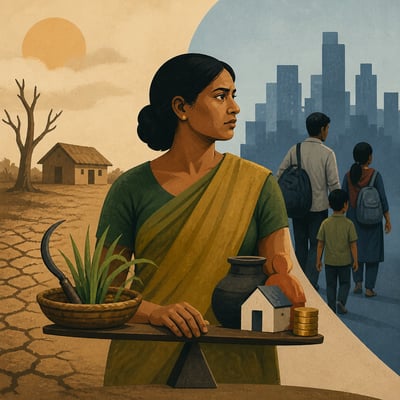
Climate pressures in South Asia are driving internal migration while reshaping who stays, who moves, and who controls household labor and resources. The strongest pattern is a gendered reorganization of work and authority, with women often carrying more farming, care, and financial responsibilities without equal control over land or leadership. The material also places this within a broader climate-migration-health context, showing that movement depends on assets, norms, and public support.

 Climate
 Privacy
 Bob Dylan
 Drones
 Data Centers
 AI Governance
 2026 Maine Senate Race