History
07/22/20260 new articles
The story is modestly reframed toward specific institutional responses and recent timing, with FIFA and the BCCI now highlighted as active actors rather than just general sports bodies. It also sharpens the scope to 2024–2026 developments and projections to 2050.
07/22/20260 new articles
The story has broadened from elite-event adaptation to a wider sports-economy and community-access problem. It now emphasizes that climate hazards are threatening participation, facilities, and revenues across grassroots and commercial sports, not just altering competition conditions.
- Flooding, storms, and rising seas are now named sports climate hazards.
- Youth and community programs are singled out as most vulnerable to disruption.
- Climate risk is linked to participation declines and sector-wide financial pressure.
- World Economic Forum and Oliver Wyman join the story as sports-economy analysts.
- UNC's climate-sport work is now associated with a dedicated research lab.
06/29/20260 new articles
The story has shifted from a broad account of climate stress in sports to a more operational framing: heat, humidity, and air quality are now being treated as direct constraints on scheduling, venue design, and safety. It also more clearly emphasizes the climate footprint of sport itself and the role of research institutions in shaping adaptation.
06/28/20263 new articles
The story has become more specific and operational: it now shows sports bodies actively changing scheduling and heat protocols, not just recognizing climate risk. It also broadens the cast of actors and evidence base, with new organizations and research directly tying climate stress to athlete safety, venue decisions, and sector finances.
- BCCI is adjusting tournament timing because of heat exposure.
- FIFA is implementing heat-mitigation rules for competitions.
- Hydration breaks and schedule shifts are now being used in practice.
- Adaptation capacity is described as uneven across organizations.
- Climate exposure is linked more directly to sports-sector revenues and participation.
05/21/20260 new articles
The story shifts from a broad climate-risk framing to a more explicit financial-and-operational one, with climate now described as a structural issue for the sports economy rather than a series of weather disruptions. It also broadens into adjacent impacts like participation demand, supply-chain disruption, and public-health/urban-planning concerns.
05/11/2026Topic Formed
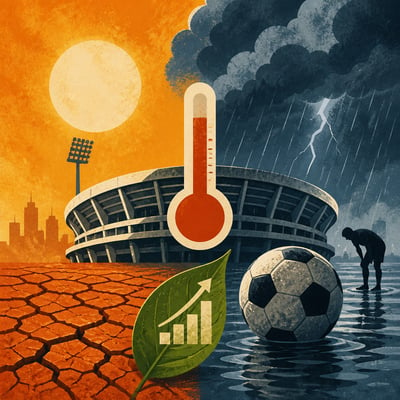
Climate change is increasingly framed as a business and operations risk for sports, with heat, poor air quality, extreme weather, and water stress affecting events, participation, venues, and industry revenue. The material also points to adaptation spending, retrofit projects, and lower-carbon operating models as emerging responses.

 Climate
 Privacy
 Bob Dylan
 Drones
 Data Centers
 AI Governance
 2026 Maine Senate Race