
Last Update: 06/03/2026 at 8:50 AM EST
Climate Risk Models Understate Losses
Coverage from Euronews.com, Green Central Banking, and others
Articles
6
Latest Article
03/26
Active Days
51
Executive Summary
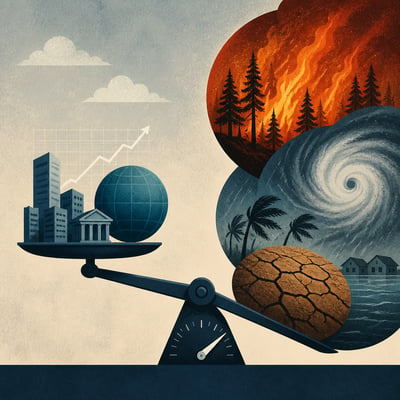
Recent reports argue that standard economic models underestimate climate damages by treating them as marginal shocks instead of structural, cascading risks. The strongest signal is a push to broaden climate-risk assessment beyond GDP and mean-temperature assumptions to include tail risks, regional shocks, insurance stress, and financial-system exposure.
Key Points
- Multiple reports argue that GDP-based climate damage functions understate physical losses and systemic disruption.
- A recurring criticism is that models rely too heavily on global average temperature and historical relationships, while missing regional shocks and non-linear effects.
- The financial stakes are framed through pensions, insurance, asset owners, and listed-company exposure to extreme-weather losses.
- Several sources call for broader metrics, including tail risk, distributional effects, mortality, and non-GDP welfare measures.
- The cluster shows a strong push for collaboration between climate scientists, economists, regulators, and asset managers.
- Supportive examples from UK asset owners suggest the modeling critique is influencing financial-risk governance, not just academic debate.
- A smaller historical thread explains how climate economics and integrated assessment models arrived at current assumptions, but current reporting is clearly dominant.
Featured Article
University of Exeter and Carbon Tracker warn in 2026 that GDP-based economic models understate cascading physical climate risks globally, stressing financial and pension vulnerabilities in the UK and beyond.
Coverage Timeline: 51 Days
Hover over any logo to see coverage summary, click for full article.
Additional Articles
⭐⭐⭐⭐⭐
In February 2026, the University of Exeter and Carbon Tracker published a global report from Europe finding economic models understate climate damages, without addressing heat-pump technologies.
The University of Exeter, Carbon Tracker Initiative, and Aurora Trust on February 5, 2026, released survey findings showing climate scientists view GDP-based climate-economic models as underestimating systemic climate risks.
⭐⭐⭐
A University of Exeter and Carbon Tracker Initiative report published in the 2020s finds mainstream economic damage functions understate climate impacts, warning UK asset owners and pension funds of underestimated risk.
Sustainable Markets Initiative and partners warn in a report that extreme weather could cost investors $1.3 trillion in near-term losses without improved modeling.
Researchers publish analysis in 2026 linking climate science and economics to inform global policy on risk and action.