History
07/23/20260 new articles
The story now emphasizes utilities and regulators actively structuring tariffs and bilateral deals to support clean firm power for large customers, while corporate procurement appears more constrained as buyer announcements slow and PPA pricing weakens. It also more explicitly frames Microsoft’s hourly clean-power goal review as evidence of strain from rising data-center demand.
07/22/20260 new articles
The story now extends beyond corporate procurement mechanics to a more explicit debate over how clean electricity claims should be measured, with hourly and locational Scope 2 accounting emerging as a major fault line. It also puts much more emphasis on the scale of 2025-2026 procurement activity and the growing pressure from AI-driven data-center demand.
- CEBA cites 27+ GW announced in 2025 and 13+ GW in Q1 2026.
- Greenhouse Gas Protocol is considering hourly and locational Scope 2 accounting.
- Support is growing among investors and 24/7 clean-energy advocates.
- Debate has emerged over transparency versus cost and procurement slowdown.
- Constraints now include infrastructure, policy uncertainty, and geopolitical instability.
06/29/20261 new articles
The story has shifted from a debate over corporate renewable accounting rules to a more practical focus on utility-linked contracts for clean firm power. The new emphasis is on how Microsoft, Amazon, and utilities are structuring deals to add capacity for data-center growth without shifting costs onto other ratepayers.
- Clean firm technologies are becoming more prominent in corporate deals.
- Corporate buyers are using utility-linked tariffs and bilateral arrangements.
- CEBA now stresses ratepayer protection in tariff design.
- Data center growth is pushing contracts to support new capacity.
- Microsoft’s hourly ambitions face growing real-time pressure.
05/28/20264 new articles
The story has shifted from a general debate over annual versus hourly clean-power matching to a sharper policy fight over how Scope 2 claims should be counted, with new emphasis on location and impact accounting. At the same time, market conditions and utility/tariff responses are now part of the core narrative, not just corporate procurement scale.
- CEBA reports record corporate clean-energy activity in the U.S.
- Higher PPA prices and more constraints are now part of the story.
- Buyer announcement activity has slowed.
- Clean energy tariffs are emerging as a response to rising load.
- Impact-accounting is now a major alternative to hourly matching.
05/16/2026Topic Formed
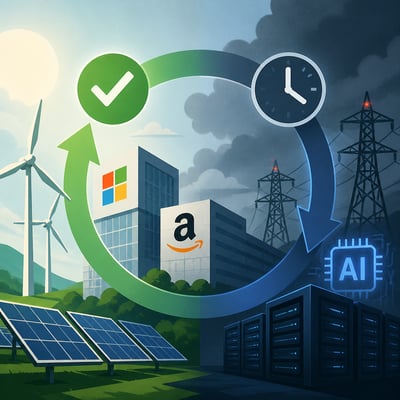
Microsoft and Amazon are expanding massive renewable power portfolios while the accounting rules behind corporate clean-energy claims are becoming more contentious. Annual renewable matching is advancing, but hourly carbon-free targets are harder to meet as AI-driven electricity demand grows and grid constraints tighten.

 Climate
 Privacy
 Bob Dylan
 Drones
 Data Centers
 AI Governance
 2026 Maine Senate Race