
 Climate
 Privacy
 Bob Dylan
 Drones
 Data Centers
 AI Governance
 2026 Maine Senate Race
Climate-Driven Food Security Risk
Coverage from Nature, The Conversation, and others
Articles
11
Active Days
158
The Topic
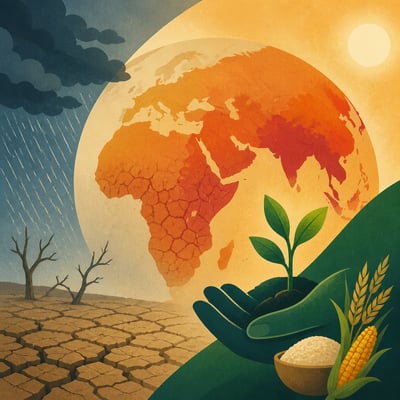
Recent coverage links climate change to worsening food security through crop losses, nutritional decline, higher food prices, and stronger pressure on vulnerable regions. The strongest signal comes from repeated modeling and review work showing risks at 1.5C to 2C, plus longer-range projections that extend hunger risk into wealthy countries and global breadbaskets. Small islands, South Korea, Europe, and parts of Africa and Asia appear as recurring exposure points. Adaptation themes repeat across the material: early-warning social protection, resilient storage and supply chains, crop breeding, water management, and broader food-system planning. The topic is coherent and fairly dense, with a mix of near-term observed stress and structural climate-food risk that remains ongoing rather than episodic.
First Article: 02/15/26
Latest Article: 07/22/26
Summary
- Climate-driven stress on food systems appears as a persistent and multi-layered risk: lower yields, weaker nutrient content, higher prices, and more frequent insecurity events.
- The most repeated exposure pathway is crop and supply disruption from heat, drought, floods, and synchronized breadbasket stress rather than a single hazard type.
- Vulnerable regions recur across the material, especially Small Island Developing States, parts of Africa and Asia, South Korea, and major grain-producing regions in Europe and North America.
- Several studies suggest the risk is not limited to poorer countries; 2040 and 2100 modeling points to food stress reaching wealthy importing and exporting states as well.
- Food quality is becoming part of the risk picture, with climate change linked to reduced micronutrient content in staple crops and broader hidden-hunger concerns.
- Adaptation responses are converging around resilient supply chains, storage, crop breeding, water management, early warning systems, and policy coordination.
- There is a strong current emphasis on scenario modeling and projection, but also enough observed climate-linked food insecurity to make the theme structurally credible rather than speculative.
History
The story broadens from general climate-linked hunger risk to a more specific global food-system framing, adding wealthy-country exposure, breadbasket synchronization, and food-trade vulnerability. It also sharpens the adaptation picture around supply chains, storage, and policy coordination.
The story has broadened from a general climate-food insecurity risk assessment into a more specific account of how climate shocks damage nutrition, crop functioning, and even public health. The framing now puts greater emphasis on heat, diet quality, and cardiometabolic consequences while still reinforcing that deep mitigation and adaptation can reduce harm.
Featured
Timeline: 158 Days
Hover over any logo to see coverage summary, click for full article.