History
07/23/20260 new articles
The story has moved from a broad account of pilot and partnership activity to clearer evidence of commercialization, with Denmark's Aalborg Portland project now framed as a funded contract starting in 2030. The current version also adds more concrete scale and performance details from the German and French pilots, strengthening the sense that cement carbon capture is entering execution rather than just experimentation.
07/22/20262 new articles
The story broadens from a mostly European cement-CCS rollout to a wider industrial carbon-capture push that now includes India, sector coordination, and more varied capture methods. It also adds concrete execution milestones, especially Denmark-backed financing for Aalborg Portland and new pilot and demonstration activity in France, Germany, and Gujarat.
- Industry groups are coordinating policy, expertise, and investment support for cement CCS.
- Denmark backed Aalborg Portland's integrated capture, transport, and storage project.
- France and Germany launched new cement capture demonstrations.
- Ambuja Cements and Leilac are evaluating capture technology in Gujarat.
- A Danish waste-incineration pilot reported capture rates up to 95%.
06/29/20262 new articles
The story broadens beyond Europe into a wider CCS commercialization theme, with new examples in India and waste treatment showing the same capture-and-storage model spreading across sectors. The European cement pipeline is also more concrete, with projects moving closer to construction or final planning under public funding and infrastructure dependencies.
- Ambuja Cements enters with a CCS evaluation in India.
- NG Nordic appears in a hazardous-waste CCS pilot.
- EU Innovation Fund backs France's largest planned cement CCS project.
- Projects are now described as nearing construction or final planning.
- The story now includes non-cement CCS commercialization examples.
06/13/20263 new articles
The story has shifted from general project advancement to a more concrete deployment phase, with pilots, demonstration platforms, and major funding structures now explicitly highlighted. It also broadens the emphasis from individual cement projects to the infrastructure and subsidy systems needed to make CCS work at scale.
- New pilots and demonstration platforms are being commissioned across Europe.
- Long-term subsidy contracts are securing revenue certainty for CCS projects.
- Transport infrastructure now includes pipelines, liquefaction, and export hubs.
- Industry groups are building coordination structures around CCS adoption.
06/06/20263 new articles
The story has shifted from general project advancement to concrete execution: several European cement CCS projects are now approved or financed, with named sector coordination supporting deployment. The emphasis is also broader and more specific on the logistics needed to make these projects work, especially cross-border transport and permanent storage networks.
- Several projects are now described as approved or financed, not just planned.
- Aalborg Portland is a new named project actor.
- GCCA and the Global CCS Institute are new coordination actors.
- Projects are now tied to specific capture volumes around 0.8 to 1.25 MtCO2 annually.
- Belgium, Denmark, Spain, and the United Kingdom are newly visible in the story.
05/18/2026Topic Formed
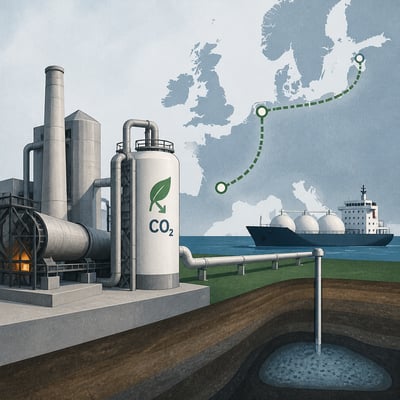
European cement companies are advancing large carbon capture projects backed by public funding, with new capture systems, transport links, and storage plans taking shape in France, Belgium, and the Baltic region. The main pattern is a shift from concept to infrastructure planning, but final execution still depends on regulation, transport access, and storage capacity.

 Climate
 Privacy
 Bob Dylan
 Drones
 Data Centers
 AI Governance
 2026 Maine Senate Race