
 Climate
 Privacy
 Bob Dylan
 Drones
 Data Centers
 AI Governance
 2026 Maine Senate Race
Glacier Retreat Raises Coastal Hazard Risks
Coverage from The New York Times, The Guardian, and others
Articles
11
Active Days
109
The Topic
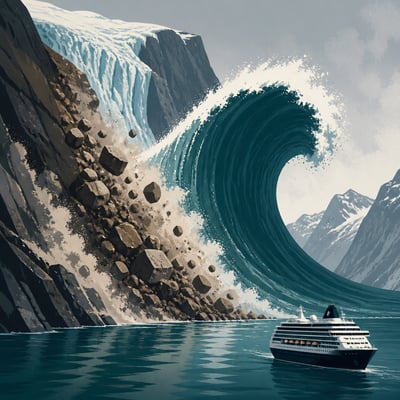
Glacier retreat is intensifying concern about both long-term sea-level rise and sudden hazards in steep coastal environments. Research and field expeditions are documenting weakening ice structures at Antarctica’s Thwaites Glacier while linking retreating glaciers and destabilized slopes in Alaska to an exceptionally large fjord tsunami. The developments underscore the need for better polar observations, hazard monitoring, and coastal preparedness, although the timing and scale of future impacts remain uncertain.
First Article: 03/17/26
Latest Article: 07/03/26
Summary
- Thwaites Glacier’s eastern ice shelf is heavily fractured and providing less resistance to upstream ice flow.
- Warm ocean water and changing circulation are contributing to thinning beneath and around Thwaites Glacier.
- A 2025 landslide in Alaska’s Tracy Arm generated a tsunami with runup of about 481 meters and a seiche lasting roughly 36 hours.
- Researchers linked the Alaska event to glacier retreat and associated slope destabilization, while noting that such failures can occur with little warning.
- Thwaites’ continued weakening could add substantially to global sea-level rise over decades and increase exposure for low-lying coastal cities.
- Expeditions using drilling, radar, underwater robots, satellites, and animal-borne sensors are improving observations, but severe Antarctic conditions limit data collection and forecasting.
History
The story now puts more emphasis on the Antarctic observation effort itself, adding new expedition details and making clear that data limits in extreme conditions constrain forecasting. It also sharpens the Alaska hazard as an exceptionally large, hard-to-predict fjord tsunami rather than just a major landslide event.
The story now includes a more specific, time-bound assessment of Thwaites’ deterioration, with scientists estimating a 33% increase in ice flow and emphasizing the eastern ice shelf’s weakening buttressing effect. It also adds a concrete Alaska disaster timeline and magnitude, making the glacier-retreat hazard link more immediate and better documented.
Featured
Timeline: 109 Days
Hover over any logo to see coverage summary, click for full article.