History
07/23/20260 new articles
The story now puts more emphasis on the Antarctic observation effort itself, adding new expedition details and making clear that data limits in extreme conditions constrain forecasting. It also sharpens the Alaska hazard as an exceptionally large, hard-to-predict fjord tsunami rather than just a major landslide event.
07/22/20261 new articles
The story now includes a more specific, time-bound assessment of Thwaites’ deterioration, with scientists estimating a 33% increase in ice flow and emphasizing the eastern ice shelf’s weakening buttressing effect. It also adds a concrete Alaska disaster timeline and magnitude, making the glacier-retreat hazard link more immediate and better documented.
- Thwaites' ice flow increased about 33% between 2020 and 2026.
- The eastern ice shelf is heavily fractured and losing buttressing.
- The Tracy Arm tsunami occurred on 10 August 2025.
- The tsunami produced water levels exceeding 480 meters.
- A seiche persisted for about 36 hours after the landslide.
06/29/20262 new articles
The framing shifts from a two-track climate-hazard story to a more Thwaites-centered narrative, with sharper emphasis on how uncertain the collapse timeline remains despite rising concern. The Alaska landslide-tsunami example is retained, but the main new emphasis is on contrasting long-term sea-level risk with uneven local preparedness and disputed imminence.
05/29/20264 new articles
The story has broadened from a single Alaska fjord landslide-tsunami case into a wider climate-risk framing that also centers on Thwaites Glacier and Antarctic ice loss. That shift adds a new long-term sea-level-rise dimension alongside the original short-warning fjord hazard.
- Thwaites Glacier is now a central focus of the story.
- Warm ocean water and thinning ice are weakening Thwaites' stability.
- Field campaigns are using drilling, radar, robots, and ocean measurements.
- Weather, sea ice, and technical failures constrain polar observations.
05/13/2026Topic Formed
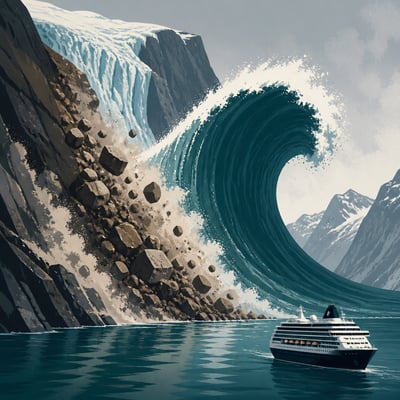
A major rockslide in Alaska's Tracy Arm fjord generated a 481-meter tsunami and a long-lived seiche, making it one of the largest known non-earthquake tsunamis. Researchers link the event to rapid glacier retreat and related slope destabilization, raising concern that warming-driven changes are increasing landslide-tsunami risk in fjords and other steep coastal settings. The case matters because the affected area is also used by cruise traffic and other vessels, making future events a public-safety and monitoring issue.

 Climate
 Privacy
 Bob Dylan
 Drones
 Data Centers
 AI Governance
 2026 Maine Senate Race