History
07/22/20260 new articles
The story shifts from a broad case for electrification to a more specific policy and infrastructure problem: the limiting factors are now framed as electricity affordability, grid constraints, and fuel-price exposure. It also adds clearer quantitative benchmarks for the EU and global electrification targets.
07/22/20260 new articles
The story is reframed more explicitly around electrification as a multi-sector demand and infrastructure challenge, not just a clean-power expansion story. It also adds clearer emphasis on heat pumps, electric vehicles, and grid-flexibility requirements as the main bottlenecks to progress.
07/22/20261 new articles
The story has become more geographically and sectorally specific: Europe’s electrification gap is now quantified, and China’s remaining challenge is framed around decarbonizing heavy industry with dependable clean power. The emphasis also expands from grids and pricing to include flexibility, storage, and digital tools as enabling infrastructure.
- EU electricity share must rise from 24% to 32% by 2030.
- About 600 TWh of new EU demand is implied by electrification targets.
- China’s heavy industry now dominates the remaining emissions challenge.
- AI and digital controls are cited as industrial efficiency tools.
- Data centers are adding new electricity-demand pressure.
06/29/20260 new articles
The story shifts from a broad case for electrification to a more pointed critique of execution: current policy and infrastructure are not scaling fast enough, and the emphasis is now on making electrification affordable and competitive for end users. It also places greater weight on buildings and industry as the leading areas of progress, while transport remains the weakest link.
06/22/20264 new articles
The story broadens from a general electrification-and-grid constraint narrative into a more specific 2026 policy and investment picture, with China added as a major decarbonization case and capital shifting toward enabling infrastructure. The framing also becomes more urgent around how fast electrification can scale, not whether it is the right direction.
06/13/20263 new articles
The story has broadened from a general electrification push into a more explicit cross-sector strategy spanning heating, transport, and industry. Europe remains central, but the framing now puts energy security, domestic clean-tech manufacturing, and policy execution more clearly at the center.
05/19/20260 new articles
The story is broadly stable, but the framing has sharpened toward electrification as a competitiveness and energy-security strategy, not just a climate measure. Europe is now the clearest regional reference point, and the operational constraints remain the same.
05/11/2026Topic Formed
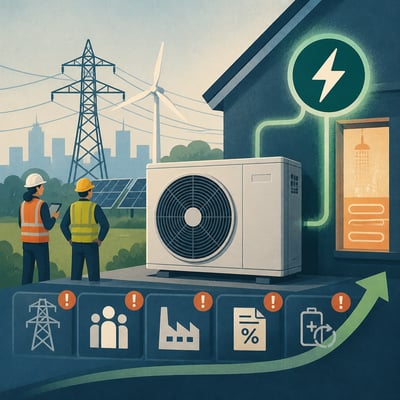
The cluster is centered on electrification as the main climate and competitiveness pathway, with heat pumps as the most repeated application. Current coverage emphasizes scale-up constraints rather than basic technology uncertainty: grid investment needs, workforce shortages, manufacturing capacity limits, electricity tax and policy barriers, and the need for storage and flexibility. A smaller historical layer frames heat pumps and electrification as established policy and transformation themes, but the current signal is more operational and deployment-focused.

 Climate
 Privacy
 Bob Dylan
 Drones
 Data Centers
 AI Governance
 2026 Maine Senate Race