
 Climate
 Privacy
 Bob Dylan
 Drones
 Data Centers
 AI Governance
 2026 Maine Senate Race
Hawaiʻi Weighs Solar, Storage, LNG
Coverage from CleanTechnica, Deutsche Welle, and others
Articles
14
Active Days
109
The Topic
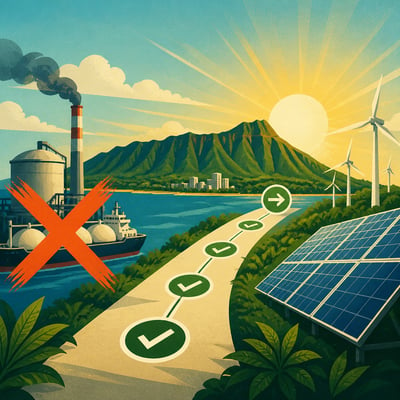
Hawaiʻi is advancing an island-by-island transition from imported fossil fuels toward renewable electricity, with solar, battery storage, electrification, geothermal power, and grid modernization at the center of planning. Recent Oʻahu modeling finds that reducing solar development costs and avoiding additional fuel-burning plants could lower long-term customer costs, while Hawaiian Electric and policymakers continue to consider LNG, renewable-fuel, and geothermal options. The transition remains shaped by land constraints, community concerns, resilience needs, and the distinct operating conditions of each island.
First Article: 03/23/26
Latest Article: 07/09/26
Summary
- Solar paired with battery storage is identified by UHERO as the lowest-cost central path for Oʻahu under its modeled assumptions.
- UHERO estimates that reducing solar permitting, interconnection, and other soft costs could save Oʻahu customers about $3.4 billion from 2027 to 2050.
- The reports argue that Oʻahu may not need an additional large fuel-burning plant, challenging proposed LNG and renewable-fuel generation projects.
- Hawaiian Electric is seeking proposals for up to 35,800 MWh of dispatchable solar-plus-storage generation on Lānaʻi, targeted for service by December 2030.
- Geothermal power, including enhanced geothermal systems, remains a potential complement to solar, but its cost and development prospects are uncertain.
- Land availability, permitting, shipping and construction costs, cultural concerns, and community benefits remain material constraints on renewable buildout.
- Transportation decarbonization is more difficult than electricity decarbonization because Hawaiʻi remains dependent on aviation and shipping.
History
The story now places greater weight on implementation: Hawaiian Electric has moved from general planning to a concrete Lānaʻi procurement for dispatchable solar-plus-storage, while the Oʻahu modeling has been sharpened into a clearer case against additional fuel-burning plants. The framing also tightens around cost-reduction assumptions and the practical constraints that still shape Hawaiʻi’s island-by-island transition.
The story has sharpened from a broad clean-energy planning contest into a more quantified, Oʻahu-centered case for solar and storage, anchored by new cost estimates and more explicit criticism of LNG and other fuel-burning alternatives. It also adds geothermal and Lānaʻi procurement as concrete pieces of the transition rather than just general planning themes.
Featured
Timeline: 109 Days
Hover over any logo to see coverage summary, click for full article.