History
07/24/20260 new articles
The story now places greater weight on implementation: Hawaiian Electric has moved from general planning to a concrete Lānaʻi procurement for dispatchable solar-plus-storage, while the Oʻahu modeling has been sharpened into a clearer case against additional fuel-burning plants. The framing also tightens around cost-reduction assumptions and the practical constraints that still shape Hawaiʻi’s island-by-island transition.
07/23/20260 new articles
The story has sharpened from a broad clean-energy planning contest into a more quantified, Oʻahu-centered case for solar and storage, anchored by new cost estimates and more explicit criticism of LNG and other fuel-burning alternatives. It also adds geothermal and Lānaʻi procurement as concrete pieces of the transition rather than just general planning themes.
- UHERO estimates $3.4 billion in Oʻahu customer savings from lower soft costs.
- Hawaiian Electric disputes some solar-and-storage cost assumptions.
- Enhanced geothermal systems are highlighted as a potential non-solar resource.
- A Lānaʻi renewable project is targeted for December 2030 service.
- Transportation, aviation, and shipping remain hard to decarbonize.
07/23/20263 new articles
The story has broadened from a mainly Oʻahu solar-and-storage planning debate into a more explicit statewide contest between clean-energy buildout and LNG as a bridge or backup option. The latest version also gives more weight to operational execution and affordability pressures, not just long-term decarbonization targets.
07/01/20264 new articles
The story has sharpened from a broad clean-energy transition into a more specific Oahu-centered debate over how fast solar-plus-storage can replace fossil backup, with cost and reliability modeling now driving the agenda. It also adds clearer evidence of active procurement and planning, including Lanai supply development and more explicit rejection of new fuel-burning generation.
- Oahu is now the main focus for electricity system planning.
- Solar-plus-storage is framed as the lowest-cost path if soft costs fall.
- LNG import proposals are being rejected or downgraded.
- Hawaiian Electric is advancing Lanai procurement for dispatchable renewable supply.
- Planning now includes hourly modeling and public tracking.
05/30/20261 new articles
The story has shifted from planning-oriented decarbonization language to a clearer execution bottleneck narrative: Hawai'i is now framed as trying to build solar-and-storage projects and grid upgrades while permitting, interconnection, and construction delays slow deployment. Community-benefit conditions on local procurement are also more explicit than before.
05/16/2026Topic Formed
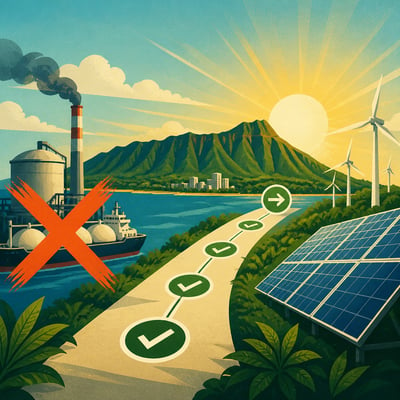
Hawai'i's clean-energy discourse is now focused on turning Oahu decarbonization plans into executable steps, using five-year milestones, hourly modeling, and near-term solar-plus-storage procurement. The material consistently argues that electrification, local solar, storage, and grid upgrades can reduce imported fuel dependence while keeping the island system reliable.

 Climate
 Privacy
 Bob Dylan
 Drones
 Data Centers
 AI Governance
 2026 Maine Senate Race