

Heat-Driven Health Risk and Inactivity
Coverage from The Guardian, EurekAlert!, and others
Articles
21
Latest Article
05/29
Active Days
964
Executive Summary
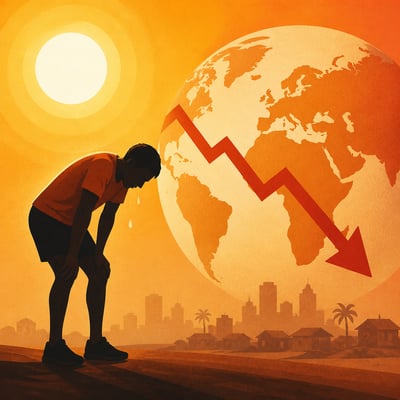
Recent reporting and studies converge on the same pattern: rising heat is reducing safe outdoor activity, increasing heat-related mortality, and exposing large regional and income-based gaps in adaptation capacity. The strongest signal comes from modeling and projection studies, especially on inactivity, cardiovascular risk, and heat deaths in hotter, poorer regions. A second thread shows that adaptation is becoming more operational, with attention to shaded streets, cooled facilities, forecast quality, and public-health warning systems. The topic is coherent and fairly dense, but much of the evidence is still model-based rather than observed outcomes, so uncertainty remains around exact magnitudes, local variation, and which adaptation measures will scale best.
Key Points
- The dominant evidence base is a set of multi-country and U.S.-focused studies linking hotter conditions to lower physical activity, higher cardiovascular strain, and more premature deaths.
- Several studies use similar thresholds and patterns: months above about 27.8 C are associated with higher inactivity, while hotter and lower-income regions face the largest modeled burdens.
- Heat mortality is emerging as a major adaptation concern, with projections pointing to especially high risks in the Sahel, Pakistan, parts of South Asia, and other hotter, poorer regions.
- Adaptation responses recur across the material: shaded streets, cooler urban design, indoor or air-conditioned exercise options, heat advisories, and better short-term weather forecasts.
- A growing thread emphasizes inequality inside countries, not just between them, with lower-income communities, rural areas, older adults, and workers facing disproportionate risk.
- Newer pieces add a perception gap theme in the United States, where public concern often trails assessed heat risk in counties that are already vulnerable.
- Most of the signal is forward-looking and model-based, so the cluster is stable in theme but still uncertain in exact estimates and local translation.
Featured Article
Coverage Timeline: 964 Days
Hover over any logo to see coverage summary, click for full article.