History
07/23/20260 new articles
The story now emphasizes a broader softening of renewable-energy insurance, with more explicit focus on systemic supply-chain and installation constraints shaping underwriting. It also reframes climate-housing insurance more clearly as an affordability and neighborhood-inequality issue, not just a coverage-availability problem.
07/22/20262 new articles
The story has become more specific and market-oriented: it now emphasizes softer renewable insurance pricing for strong projects alongside much tougher technical underwriting. It also adds a broader set of risk factors, especially supply-chain concentration and battery-storage hazards, while keeping the household affordability problem in view.
- WTW reports 20% to 30% rate cuts for well-engineered renewable projects.
- Competition and new capacity are softening the renewable insurance market.
- Chinese solar and battery supply-chain concentration is a new underwriting concern.
- Battery storage thermal runaway is highlighted as an insurer constraint.
- Mesoamerican Reef appears as a new resilience-financing example.
06/29/20260 new articles
The story broadens from clean-energy project insurance into a wider framing of financial institutions shaping both transition finance and climate-risk outcomes in housing markets. The biggest new angle is the explicit Florida homeowners insurance example, which shifts the focus from insuring projects to how climate losses are already affecting affordability and displacement.
06/18/20264 new articles
The story is now more specific about how insurance is enabling clean energy finance: underwriting is tighter and more selective, especially around storage, project quality, and supply-chain concentration. It also adds market evidence of softer pricing for stronger renewable risks, alongside continued criticism over fossil-fuel support and climate-exposed coverage cuts.
- Renewable pricing is softening for better-engineered risks.
- Underwriters are focusing more on battery thermal runaway and decommissioning.
- Supplier concentration is now a highlighted underwriting concern.
- Lifecycle risk management is emphasized across design through workforce quality.
- Criticism now includes banks and investors enabling fossil-fuel expansion.
05/30/20260 new articles
The story shifts from a broad emphasis on insurance as clean-energy financing to a more explicit framing of insurance as a practical tool for revenue protection, climate adaptation, and faster-pay loss recovery. At the same time, the criticism side is sharpened: insurers are now more clearly cast as still enabling fossil fuel expansion while retreating from hazard-exposed communities.
05/11/2026Topic Formed
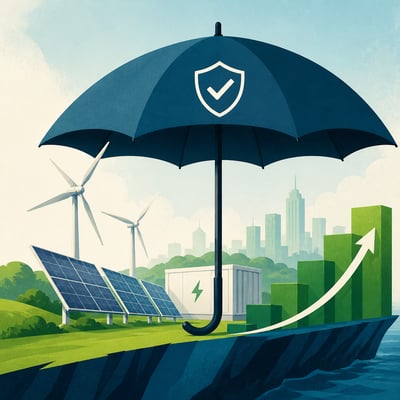
Insurance is being used as a financing tool for clean energy and climate-tech projects, while wider debate continues over insurer exposure to fossil fuels, disaster losses, and rising coverage costs in high-risk areas. The strongest recurring pattern is the link between risk transfer, bankability, and deployment speed.

 Climate
 Privacy
 Bob Dylan
 Drones
 Data Centers
 AI Governance
 2026 Maine Senate Race