
 Climate
 Privacy
 Bob Dylan
 Drones
 Data Centers
 AI Governance
 2026 Maine Senate Race
Last Update: 08/01/2026 at 3:33 PM EST
Low-Energy Carbon Capture Materials
Coverage from MIT News, EurekAlert!, and others
Articles
9
Active Days
79
The Topic
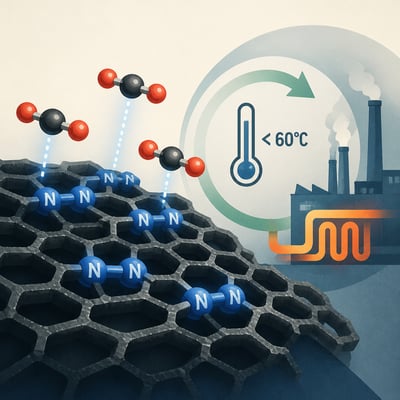
Recent coverage shows a concentrated burst of research on nitrogen-engineered carbon sorbents that improve CO2 capture and reduce regeneration energy, especially materials that can release CO2 below 60 C and potentially use industrial waste heat.
First Article: 01/01/00
Latest Article: 06/04/26
Summary
- The strongest current signal is materials research on carbon sorbents designed to capture CO2 with lower regeneration energy.
- Chiba University's viciazite materials recur across the newest articles and provide the main empirical anchor for the cluster.
- The key technical pattern is controlled placement of adjacent nitrogen functional groups, rather than random nitrogen doping.
- Performance gains are tied to two linked outcomes: improved CO2 uptake and lower desorption temperatures, often below 60 C.
- The practical appeal is compatibility with industrial waste heat, which could reduce operating costs for carbon capture systems.
- Several articles also note a durability tradeoff, where some nitrogen configurations may improve stability but require higher release temperatures.
- A smaller historical signal appears around carbon nanotube activation, but it is less central than the newer viciazite work.
History
The story is largely unchanged, but the current version sharpens the framing around a broader set of nitrogen-engineered carbon sorbents and adds a durability tradeoff: some nitrogen configurations may improve stability while raising release temperatures.
Featured
06-04-2026
MIT researchers evaluate N-heterocyclic imine sorbents for electrochemically mediated CO2 capture, aiming to reduce energy demands versus amine scrubbing in future scalable systems.
01-01-1900
Researchers in Moscow report that ambient air heating of single-walled carbon nanotubes doubles surface area and increases CO2 uptake.
03-25-2026
Chiba University researchers reported viciazites with adjacent nitrogen sites that improved CO2 uptake and enabled desorption below 60 C for potentially lower-energy regeneration.
Timeline: 79 Days
Hover over any logo to see coverage summary, click for full article.
Additional Articles
⭐⭐⭐⭐⭐
MIT researchers, with support from the MIT Climate and Sustainability Consortium, study N-heterocyclic imine sorbents for electrochemically mediated CO2 capture as a scalable alternative to amine scrubbing.
⭐⭐⭐
Chiba University researchers published a viciazites CO2 capture material in Carbon with low-temperature CO2 release below 60 C for waste-heat regeneration.
Researchers at Chiba University report viciazites nitrogen-doped carbon materials that capture CO2 and release most CO2 below 60 C for potentially lower-energy capture.
Chiba University researchers report viciazites carbon materials with adjacent nitrogen groups enabling CO2 release below 60 C for lower-energy capture.
Scientists at Chiba University in Japan report viciazite, a nitrogen-architected CO2 adsorbent that enables low-temperature CO2 desorption for reduced carbon capture energy use.
Chiba University researchers reported viciazite nitrogen-functionalized carbon adsorbents with adjacent -NH2 groups that improved CO2 uptake and enabled regeneration below 60 C.