
 Climate
 Privacy
 Bob Dylan
 Drones
 Data Centers
 AI Governance
 2026 Maine Senate Race
Last Update: 08/01/2026 at 2:00 PM EST
Upcycled Nitrile Rubber Carbon Capture
Coverage from American Chemical Society, Ars Technica, and others
Articles
4
Active Days
102
The Topic
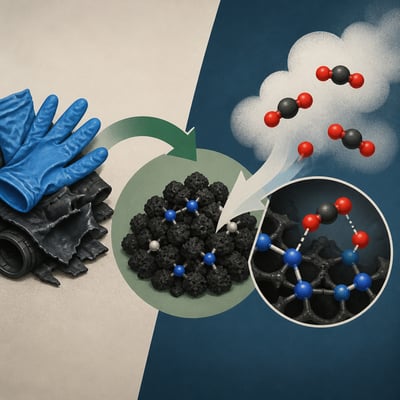
Researchers are turning discarded nitrile rubber, including gloves and shoe soles, into amine-rich materials that can capture carbon dioxide at high temperatures, while scale-up, catalyst cost, and stability remain open questions.
First Article: 02/27/26
Latest Article: 06/08/26
Summary
- A small set of recent studies shows a shared route: hydrogenating nitrile rubber waste into amine-functional materials that bind CO2.
- The strongest experimental signal is high-temperature performance, with adsorption reported around 90 C under flue-gas-like conditions.
- The work is framed as circular materials innovation, using discarded gloves, O-rings, and shoe soles as feedstock rather than virgin polymer.
- Catalyst expense, oxidative stability, and processing of crosslinked or vulcanized waste remain the main barriers to industrial use.
- Results are being compared with established capture materials such as CALF-20 MOF, suggesting the new materials are promising but not yet clearly superior.
- The topic is still early-stage and research-led, with little evidence of deployment beyond laboratory demonstrations.
History
The story is largely unchanged, but the current version more explicitly broadens the feedstock to shoe soles and clarifies that the main unresolved issues are cost and stability at scale. It also tightens the framing around flue-gas-relevant high-temperature capture rather than general CO2 adsorption.
Featured
02-27-2026
Aarhus University researchers convert glove nitrile rubber into carbon capture polyamine membranes in 2026 in Denmark.
06-08-2026
Ruth Ebenbauer at Aarhus University reports upcycled polystyrene converted to solid amine sorbents for CO2 capture tested under smokestack and ambient-air conditions.
02-27-2026
Researchers at Aarhus University convert nitrile glove waste into CO2 capture material and test uptake at 90 C in laboratory conditions.
Timeline: 102 Days
Hover over any logo to see coverage summary, click for full article.
Additional Articles
⭐️⭐️
Aarhus University and the University of St Andrews report hydrogenation-based upcycling of nitrile glove and shoe waste into polymers for CO2 adsorption and stretchable materials.