

Last Update: 06/03/2026 at 2:25 PM EST
Nature Finance And Biodiversity Funding
Coverage from Earth.Org, Deutsche Welle, and others
Articles
3
Latest Article
01/22
Active Days
8
Executive Summary
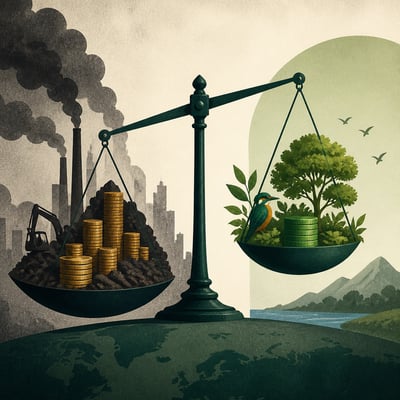
Recent coverage shows a strong policy-and-finance push to redirect capital toward biodiversity protection, while nature-damaging investments remain vastly larger than nature-positive finance. The main tension is between ambitious biodiversity goals and the slow pace of actual capital reallocation.
Key Points
- Nature-harming investment is still far larger than nature-positive finance, with UNEP estimating $7.3 trillion versus $220 billion in 2023.
- Public policy remains central, especially subsidy reform, investment standards, and frameworks meant to shift capital away from fossil fuels and other damaging sectors.
- Blended finance and catalytic capital are emerging as the main tools for scaling forest, ocean, and broader nature-based projects.
- Biodiversity governance is increasingly tied to implementation finance, not just targets, with COP17 and the Kunming-Montreal framework as key reference points.
- Blue finance and forest finance are becoming more structured through guidance, protocols, and new facilities aimed at making projects investable.
- The topic is coherent and structural rather than episodic: the same financing gap and policy responses recur across the material.
Featured Article
UNEP reports in 2023 that $7.3 trillion of global investments harm nature while nature-positive finance reached $220 billion, urging policy and private shifts worldwide.
Coverage Timeline: 8 Days
Hover over any logo to see coverage summary, click for full article.
Additional Articles
⭐⭐⭐⭐⭐
The UN Environment Programme released a report finding that 2023 global investments in nature-harming activities outpaced nature-based solutions by roughly 30 to 1 worldwide.
⭐⭐⭐
UNEP FI and partners highlight finance mechanisms and governance at COP17 in Yerevan in 2026 to scale investment for forests, oceans, and Indigenous-directed nature finance.