History
07/23/20260 new articles
The main change is a reframing from a broad policy rollout to a clearer implementation push, with stronger emphasis on affordability measures and additional program actors. The underlying clean-energy agenda is otherwise largely the same.
07/22/20261 new articles
The story broadened from primarily workforce funding into a wider clean energy deployment program centered on distributed solar, electrification, EV-grid integration, and grid reliability. The new version also adds concrete implementation milestones, including 8 GW of solar capacity and multiple funded projects and training outcomes.
- Distributed solar reached 8 GW, ahead of the 2030 target.
- More than $6 million funds EV grid-integration projects.
- Workforce grants aim to place over 1,000 New Yorkers.
- Programs now include high-performance construction and energy resilience.
- Grid flexibility and peak-demand management are explicit goals.
06/29/20262 new articles
The story now narrows from a broad clean-energy workforce and deployment push to a more specific NYSERDA-backed training expansion, with clearer program names and eligibility rules. It also adds that related clean transportation and building decarbonization funding is reinforcing the same implementation agenda.
05/30/20262 new articles
The story has broadened from workforce funding alone to include new state-backed technology demonstration programs, especially for affordable building electrification and vehicle-grid integration. That shifts New York’s clean energy push from mostly labor pipeline support toward more direct implementation pilots tied to grid modernization.
- About $320 million in statewide clean energy workforce support is now cited.
- NYSERDA is funding affordable building electrification demonstrations.
- Vehicle-grid integration pilot funding is now included.
- Bidirectional charging and managed charging are new focus areas.
- Implementation pilots are now part of the story.
05/12/2026Topic Formed
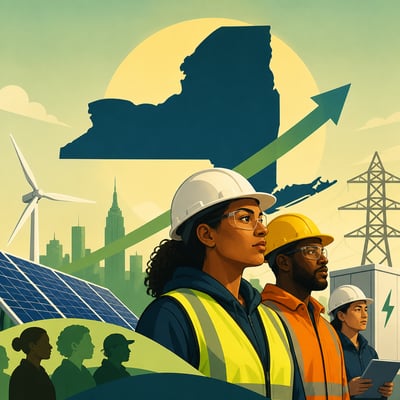
New York is expanding state-backed clean energy workforce programs with new funding, training capacity, and job-placement pathways tied to efficiency, electrification, renewables, storage, and grid work. The main pattern is implementation support for the energy transition, with strong equity requirements and repeated emphasis on building labor capacity for near-term deployment.

 Climate
 Privacy
 Bob Dylan
 Drones
 Data Centers
 AI Governance
 2026 Maine Senate Race