
 Climate
 Privacy
 Bob Dylan
 Drones
 Data Centers
 AI Governance
 2026 Maine Senate Race
Ohio Blocks Clean Energy as Demand Rises
Coverage from Canary Media, Farm and Dairy, and others
Articles
11
Active Days
104
The Topic
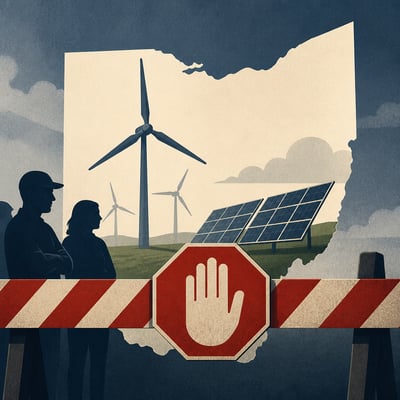
Ohio has made utility-scale wind and solar projects harder to build through setback rules, county restrictions, permitting decisions, and strong local opposition. Analysts and clean-energy advocates say more than 5.3 gigawatts of potential renewable capacity has been blocked or withdrawn, limiting low-cost power options as data centers increase electricity demand. The state is simultaneously approving behind-the-meter natural gas plants with battery storage, while disputes continue over farmland use, local authority, grid needs, and consumer costs.
First Article: 03/26/26
Latest Article: 07/07/26
Summary
- More than 5.3 GW of Ohio wind and solar capacity was reportedly blocked, rejected, withdrawn, or otherwise not built over roughly 12 years.
- Setback rules, Senate Bill 52, county bans, and local opposition have increased barriers to utility-scale renewable permitting.
- Ohio’s renewable shortfall is emerging alongside rapid data center growth and large new electricity and water demands.
- The Ohio Power Siting Board continues to approve some projects but has also rejected major solar proposals, often citing local government and public opposition.
- Behind-the-meter natural gas plants with battery storage are being approved in New Albany to serve data centers affiliated with Meta and other operators.
- Farmland preservation remains a central argument against solar, while industry and environmental groups cite limited land coverage and agrivoltaic alternatives.
- Supporters of additional renewables argue that lost wind and solar generation could have reduced emissions and expanded access to low-marginal-cost electricity.
History
The story now more explicitly links Ohio’s renewable siting constraints to the state’s fast-growing data center load, while adding that regulators are still approving some projects and new behind-the-meter gas-and-battery builds. The update also sharpens the framing around New Albany and the Meta-linked project as a live example of how new demand is being met.
The story now puts more emphasis on the growing electricity and water strain from data centers and on Ohio’s approval of behind-the-meter natural-gas plants as an alternative supply path. It also broadens the framing from renewable siting restrictions alone to the wider power-mix and local-control debate.
Featured
Timeline: 104 Days
Hover over any logo to see coverage summary, click for full article.