History
07/22/20260 new articles
The story now more explicitly links Ohio’s renewable siting constraints to the state’s fast-growing data center load, while adding that regulators are still approving some projects and new behind-the-meter gas-and-battery builds. The update also sharpens the framing around New Albany and the Meta-linked project as a live example of how new demand is being met.
07/22/20260 new articles
The story now puts more emphasis on the growing electricity and water strain from data centers and on Ohio’s approval of behind-the-meter natural-gas plants as an alternative supply path. It also broadens the framing from renewable siting restrictions alone to the wider power-mix and local-control debate.
07/22/20263 new articles
The story has broadened from a general fight over renewable siting and data center demand to a more specific account of Ohio’s policy barriers, including setback rules, county restrictions, and recent approvals for behind-the-meter gas-and-battery infrastructure serving data centers. The new version also sharpens the evidence that large amounts of renewable capacity have been blocked over a long period.
06/29/20261 new articles
The story has sharpened from a general Ohio renewable-siting conflict into a more explicit statewide contest between blocked clean-energy buildout and surging data-center electricity demand. The new version also adds stronger evidence of local backlash and a concrete Ohio Supreme Court setback for a major solar project.
- More than 5.3 GW of renewable capacity was allegedly blocked or never built.
- Data center growth is now centered around Columbus and Dublin.
- Community backlash includes moratoriums and ballot efforts.
- Oak Run solar was struck down by the Ohio Supreme Court.
- Policy debates now include clean-energy definitions and reliability standards.
06/06/20263 new articles
The story has broadened from renewable permitting friction in Ohio to a more explicit, current conflict involving courts, regulators, and local governments shaping both clean-energy and data-center development. The new emphasis is on concrete recent interventions and on the added stakes for electricity prices and grid load.
- Ohio regulators and courts are intervening in individual renewable projects.
- Recent coverage highlights major solar permit reversals.
- Data-center expansion is driving zoning fights and moratorium debates.
- Blocked renewable capacity is being linked to higher consumer costs.
- Ohio-specific reporting now emphasizes electricity prices and emissions impacts.
05/18/20261 new articles
The story now extends beyond permitting restrictions alone to connect Ohio’s renewable siting limits with rising electricity demand, especially from data centers and grid-strain concerns. It also adds a clearer operational angle: the issue is increasingly about how local veto points and queue timing translate into unbuilt capacity and delayed deployment.
05/11/2026Topic Formed
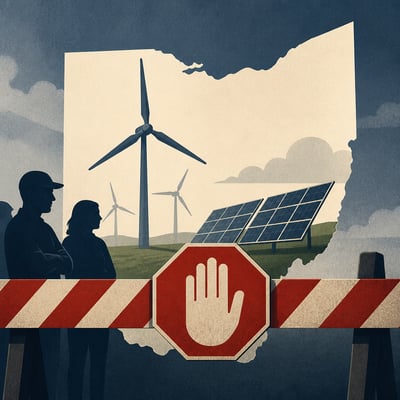
The cluster centers on Ohio’s renewable-energy permitting environment, especially how state and local siting rules shape wind and solar project outcomes. Current coverage is dominated by evidence that local opposition and post-2021 legal changes have made Ohio comparatively restrictive, with project denials, withdrawals, and contested approvals drawing attention. The broader context is a national permitting landscape that is still mostly favorable overall, but with Ohio emerging as a notable outlier.

 Climate
 Privacy
 Bob Dylan
 Drones
 Data Centers
 AI Governance
 2026 Maine Senate Race