
 Climate
 Privacy
 Bob Dylan
 Drones
 Data Centers
 AI Governance
 2026 Maine Senate Race
Perovskite Tandem Solar Moves Toward Scale
Coverage from CleanTechnica, Yahoo, and others
Articles
9
Active Days
153
The Topic
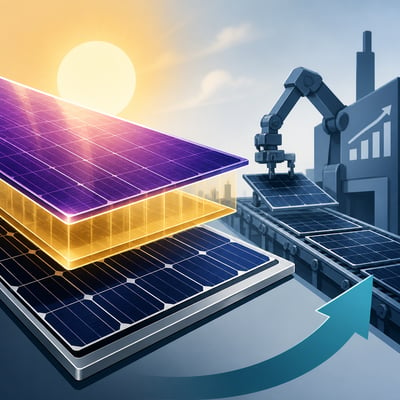
Perovskite-silicon tandem solar technology is advancing from laboratory demonstrations toward industrial manufacturing, with reported module efficiencies reaching 29.2% and research-cell results above 33%. Researchers are improving deposition, surface passivation, and module integration while companies including Trina Solar and Tandem PV pursue larger-format production and field testing. Durability, outdoor stability, lead containment, and reliable high-volume manufacturing remain the main barriers to broad adoption.
First Article: 01/31/26
Latest Article: 07/02/26
Summary
- Trina Solar reported a TÜV SÜD-verified 29.2% efficiency and 907-watt output for an industrial-size tandem module.
- Research teams in China, Germany, and Spain are addressing leakage, coating uniformity, band-gap control, and faster deposition.
- Tandem PV has opened a 40-MW-per-year demonstration line in California and is targeting full-size production in 2028.
- Outdoor durability remains unresolved, with moisture, oxygen, ultraviolet exposure, heat, reverse-bias hotspots, and lead containment posing challenges.
- Higher efficiency could produce more electricity from constrained rooftop or land areas, but current silicon technologies remain more commercially established.
- Separate III-V germanium module research reached 34.2% efficiency and is linked primarily to specialized satellite applications.
History
The story now places more weight on commercialization progress: Tandem PV has moved from a demonstration line to a stated 2028 production target, while the technical focus has broadened to include lead containment and outdoor reliability. The latest version also adds a clearer split between near-term manufacturing advances and the technology’s still-unresolved durability barriers.
The story now includes a clearer move from record-setting tandem solar research into pilot manufacturing and field validation, while durability remains the main commercial barrier. It also adds a separate high-efficiency Fraunhofer record in a different tandem architecture, broadening the performance backdrop but not changing the core commercialization challenge.
Featured
Timeline: 153 Days
Hover over any logo to see coverage summary, click for full article.