
 Climate
 Privacy
 Bob Dylan
 Drones
 Data Centers
 AI Governance
 2026 Maine Senate Race
Snowball Earth Climate Dynamics
Coverage from Astrobiology, EurekAlert!, and others
Articles
6
Active Days
23
The Topic
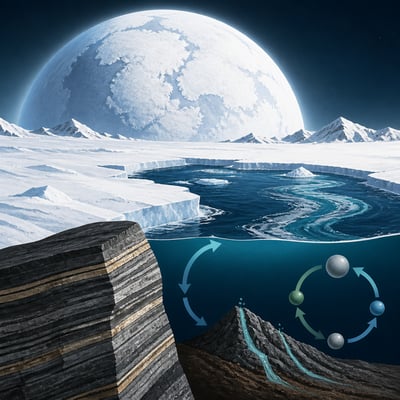
Recent research uses Cryogenian varved rocks and climate modeling to show that Snowball Earth was not perfectly static: short- and long-term climate oscillations persisted when small areas of open ocean remained, while separate work examines how carbon-cycle processes may have controlled glaciation length.
First Article: 01/01/00
Latest Article: 02/20/26
Summary
- High-resolution varved sediments from the Garvellach Islands are the main evidence base, with about 2,600 annual layers used to reconstruct Cryogenian climate variability.
- Multiple studies converge on the idea that small ice-free ocean areas, especially in the tropics, could preserve atmosphere-ocean coupling during a largely frozen Earth.
- The reconstructed variability includes annual, decadal, and centennial oscillations, sometimes compared to ENSO-like or solar-linked patterns, suggesting Snowball Earth was dynamically active rather than uniform.
- Modeling repeatedly points to a threshold near 15% open ocean for restoring recognizable climate oscillations under extreme glaciation.
- A separate modeling thread argues that seafloor weathering, by drawing down atmospheric CO2, may have strongly influenced how long Snowball Earth episodes lasted.
- The topic is internally coherent around Cryogenian climate mechanics, but it is split between sediment-based reconstruction, coupled climate simulation, and deep-time carbon-cycle explanation.
- The current signal is dense but narrow: most items reinforce the same scientific frame rather than introducing unrelated subtopics.
History
The story is largely unchanged, but the framing has been tightened: the Garvellach varve evidence is now presented as the main reconstruction base, with the narrative more explicitly linking open-ocean refuges and carbon-cycle feedbacks to persistent Snowball Earth variability.
Featured
Timeline: 23 Days
Hover over any logo to see coverage summary, click for full article.