
Last Update: 06/03/2026 at 12:25 PM EST
U.S. Climate Concern And Media Retreat
Coverage from Davis Vanguard, Earth.Org, and others
Articles
17
Latest Article
06/02
Active Days
216
Executive Summary
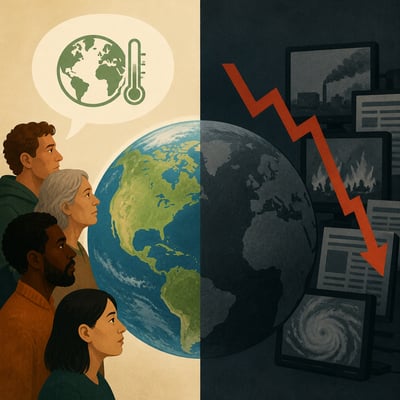
Public concern about climate change remains high in the United States, but trust, attribution, and policy expectations are split sharply by party while climate news coverage has fallen since 2021. Survey data show most Americans accept warming and human causation, yet many doubt governments will respond effectively. Across the material, media retreat and political polarization dominate alongside evidence of worsening climate signals and weaker institutional attention.
Key Points
- U.S. concern about climate change is still elevated, with most surveys showing majorities saying warming is happening and human activity is a leading cause.
- Partisan polarization remains strong: Democrats express much higher concern and attribution than Republicans, especially on human causation and government responsibility.
- Pessimism is rising about whether countries will do enough to avoid the worst climate impacts, even among respondents who see the problem as serious.
- Climate news coverage has declined since a 2021 peak in both global and U.S. media, with major outlets and broadcast networks reporting fewer climate stories and smaller dedicated teams.
- Scientists remain the most trusted source of climate information, while trust in politicians is low and media trust is mixed.
- The physical climate signal in the background is worsening, with repeated references to extreme weather, warming, glacier melt, and other observed risks.
- A persistent tension runs through the cluster: public concern and scientific warning remain visible, but media attention and political follow-through are weaker.
Featured Article
United States adults show high concern for climate change even as media coverage declines, according to fall 2025 survey.
Coverage Timeline: 216 Days
Hover over any logo to see coverage summary, click for full article.
Additional Articles
⭐⭐⭐⭐⭐
The Trump administration moved in the late 2010s to revoke the Environmental Protection Agency’s greenhouse gas endangerment finding, reshaping US climate authority and international engagement.
Earth.Org in 2026 reported that global news outlets reduced climate-change coverage in 2025 despite record emissions and consistent audience interest, without mentioning heat pumps.
Yale Project on Climate Change Communication and George Mason University Center for Climate Change Communication report in Fall 2025 that 72 percent of US adults believe global warming is happening.
U.S. media coverage of climate change declined sharply after 2021, according to University of Colorado Boulder and Media Matters metrics, amid political pressure and newsroom cuts.
Scientists and U.S. policymakers discuss growing climate risks amid federal research rollbacks and election-year shifts in climate messaging toward energy affordability.
⭐⭐⭐
Pew Research survey in the United States finds 48% of Americans attribute Earth warming to human activity and 68% report more frequent extreme weather events.
Pew Research Center surveyed 3,524 U.S. adults in mid-March 2026 and found large partisan gaps in beliefs about climate risks and readiness to address warming.
Gallup survey March 2-18 finds 44% of U.S. adults with a great deal of concern about global warming, alongside partisan splits on media underestimation and human-caused warming.
A Pew Research Center survey of 3,524 U.S. adults conducted March 16-22 finds most respondents expect insufficient global climate action, with major partisan shifts in 2026.
Pew Research Center surveyed 3,524 U.S. adults in March 2026 and found Democrats increasingly doubt the U.S. and other countries will avoid worst climate impacts.
Gallup reported March 2-18, 2026 polling showing high U.S. concern about global warming and majority human attribution, with strong partisan differences.
Boykoff argues MeCCO data showing declining climate newspaper coverage reduces public connections between climate science and governance in 2025 and early 2026.
Mark Hertsgaard-led interviews in early 2026 for a Covering Climate Now white paper describe declining 2025 climate coverage driven by newsroom priorities, politics, and staff cuts.
⭐️⭐️
In the United States, news organizations have reduced climate coverage since 2021, lowering weekly public exposure and complicating climate policy momentum.
Reuters Institute survey finds climate information trust split among media, scientists, and politicians in the 2020s.
US media coverage of climate change has declined since 2021 in the United States due to competing news priorities.