History
07/22/20260 new articles
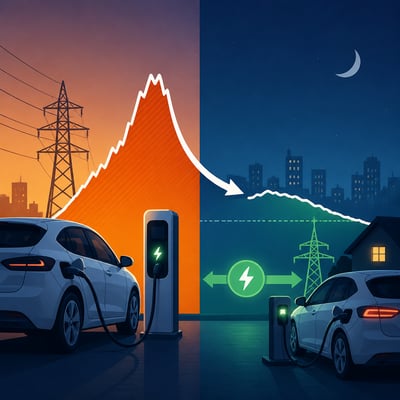
The story is now framed more explicitly around EVs as grid-flexibility assets, with greater emphasis on coordination among automakers, utilities, aggregators, and customers. It also adds ChargeScape and elevates school-bus fleets and community batteries as practical implementation channels.
07/22/20260 new articles
The story now broadens from EVs as flexible grid assets to a more explicit systems-level framing that includes community batteries, voltage stabilization, and grid investment needs. It also sharpens the barriers to adoption by emphasizing limited tariffs, participation programs, and technical integration challenges.
07/22/20260 new articles
The story has broadened from EVs as grid-support tools to a more operational picture of how bidirectional charging, school-bus fleets, and microgrids are being integrated to provide backup power and renewable balancing. The new version also clarifies that the key bottlenecks are technical compatibility, compensation design, and distribution-grid upgrades rather than just proving the technology works.
07/20/20264 new articles
The story has broadened from general EV-grid flexibility to concrete deployment of EVs as backup power and grid resources, especially in school districts and fleet settings. The new version also puts more emphasis on storage coordination and operational constraints needed to make these programs scale.
05/18/20260 new articles
The story is slightly more concrete: EV-grid coordination is now framed less as isolated pilots and more as broader utility-automaker coordination around managed charging and bidirectional export. The main takeaway remains unchanged that EV flexibility helps, but grid upgrades and incentives are still necessary.
05/11/2026Topic Formed
The cluster is centered on EVs being used as flexible grid resources rather than only transport loads. Current coverage emphasizes vehicle-to-grid, managed charging, and vehicle-to-home programs, while repeatedly noting that these tools do not remove the need for broader grid upgrades. The dominant pattern is operational and technical: utilities, automakers, and researchers are testing bidirectional charging and load shifting, but deployment remains constrained by standards, incentives, and distribution/transmission capacity.

 Climate
 Privacy
 Bob Dylan
 Drones
 Data Centers
 AI Governance
 2026 Maine Senate Race