History
07/23/20260 new articles
The update sharpens the gray-whale story from broad climate stress to a more specific, sustained decline in Eastern North Pacific gray whales, now tied to prolonged food scarcity, low reproduction, and unusually high strandings. It also slightly widens the geographic and ecological framing, but the core policy implications remain the same: vessel risk, krill pressure, and monitoring limits persist, with no proven technological substitute yet.
07/22/20262 new articles
The story broadens from a gray-whale-centered climate mortality narrative into a wider multi-species conservation picture that adds Southern Ocean krill management and new evidence that some whales may have dietary flexibility. It also sharpens the urgency around Pacific gray whales by tying poor Arctic feeding conditions to sharp population decline, reduced calf production, and higher mortality.
- Pacific gray whales now show reduced calf production, not just elevated mortality.
- Southern right whales may consume a broader range of prey than previously recognized.
- CCAMLR is now central to krill-fishing limits in the Southern Ocean.
- Monitoring gaps and carcass-based estimates limit confidence in whale trends.
- Puget Sound and the Pacific Northwest are newly named risk areas.
06/29/20261 new articles
The story is now framed more narrowly around gray whales in San Francisco Bay, with a stronger emphasis on climate-driven Arctic feeding disruption pushing them into riskier, high-traffic waters. It also adds a new management-specific finding: NOAA-commissioned review found no technology clearly replacing broad vessel speed limits for right whale protection.
05/29/20264 new articles
The story has broadened from a gray-whale decline narrative into a wider climate-and-whales protection issue that now includes North Atlantic right whales and Southern Ocean prey disruption. The main new emphasis is that shifting habitats and prey losses are outpacing existing vessel-speed, routing, and protected-area measures.
- North Atlantic right whales are now included in the whale-stress narrative.
- Southern Ocean krill losses are presented as a broader prey-supply threat.
- Current protections are described as outpaced by shifting whale ranges and prey availability.
- Washington waters join San Francisco Bay as repeated gray-whale mortality hotspots.
05/22/20260 new articles
The story has narrowed and sharpened around gray whales, dropping the broader southern right whale thread and emphasizing a more diagnostic link between Arctic warming, prey loss, and elevated mortality. San Francisco Bay and adjacent West Coast waters are now framed more explicitly as recurring mortality and collision hotspots.
05/11/2026Topic Formed
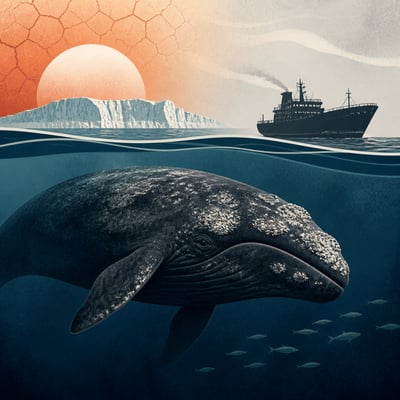
Recent coverage shows climate-related ecosystem disruption affecting whale populations through prey loss, altered migration, and higher mortality. Gray whales along the U.S. West Coast and southern right whales in the Southern Hemisphere both show signs of reproductive stress, with vessel strikes and malnutrition adding pressure.

 Climate
 Privacy
 Bob Dylan
 Drones
 Data Centers
 AI Governance
 2026 Maine Senate Race